

Got career regrets? Talk to almost any experienced professional and you’ll hear some version of a career regret. It can be staying too long in a bad situation. Or playing it too safe. Ignoring an inner nudge to change. Making choices for the wrong reasons. Getting lost in work. Roads not taken. Years spent pursuing someone else’s definition of success.
According to a survey of 1,000 workers in the U.S., U.K., France, and Germany:
- 66% of workers have work-related regrets.
- “Half of people regret being in their chosen career.” (O’Neill, 2025)
Here are the seven most common career regrets, according to the research:
Regret: Choosing a career based only on financial considerations and neglecting other important factors, like purpose, passion(s), flexibility, and autonomy. (Gulati, 2012; Pillemer, 2012)
Daniel Gulati interviewed 30 professionals ranging from age 28 to 58, asking each person about their biggest career regret so far. He writes, “By far the biggest regret of all came from those who opted into high-paying but ultimately dissatisfying careers.” (Gulati, 2012)
Dr. Karl Pillemer conducted a research project over decades that involved responses from more than 1,200 elders (age 65 and older, but most in their 70s and 80s), asking them about the important lessons they’re like to pass on to younger people. A key finding:
“…the elders believe that the biggest career mistake people make is selecting a profession based only on potential earnings. A sense of purpose and passion for one’s work beats a bigger paycheck any day.” (Pillemer, 2012)
Regret: Choosing a career based on what others think you should do (i.e., the influence of parents, teachers, classmates, society) instead of what you want to do. (Tieger et al., 2013)
The pressures are real. Especially when you’re young and still learning about yourself and not yet clear on all the options—or how to choose.
- “One of the greatest regrets in life is being what others would want you to be, rather than being yourself.” -Shannon L. Alder, author
- “…occupational regret is lived out on a daily basis as individuals labor in occupations they wish they had never entered.” -Wrzesniewski, A., Tosti, J., and Landman, J. (Yale, 2006)
Regret: Spending too much time in job that makes you unhappy, without looking for a new job. (Pillemer, 2012)
Many people are stuck in frustrating work situations. A bad boss. A toxic culture. Too much office politics. Academic researchers talk about “career inaction,” “stagnaters,” and “dysfunctional staying.” According to a survey of 1,000 workers in four countries, more people regret staying at a job too long (58%), as opposed to quitting a job (38%).
- “I wish I’d not spent so many years in an average job. Life is over so quickly.” -Pearl, an Australian retiree, as told to Bronnie Ware in The Top Five Regrets of the Dying
- “Almost uniformly, those who had actually quit their jobs to pursue their passions wished they had done so earlier.” (Gulati, 2012)
- “A big part of me looks back and thinks, ‘you know, you’ve been doing this since you were… twenty-five—you’re now nearly forty.’ And I’m thinking ‘that whole time you’ve had periods of regret, so maybe it’s not for you.’” -teacher, cited in Budjanovcanin, A., & Woodrow, C. (2022)

Regret: Getting so caught up in your career that you neglect other important aspects of your life, like health, family, and friendships. (O’Neill, 2025; Ware, 2019)
According to a survey of 1,000 workers in four countries, 59% of workers regret not prioritizing work-life balance in their career. (O’Neill, 2025)
“I wish I hadn’t worked so hard…. What a stupid fool I was. I worked too damn hard and now I am a lonely, dying man. The worst part is that I have been lonely for the whole of my retirement and I need not have been…. There is nothing wrong with loving your work and wanting to apply yourself to it, but there is so much more to life.” -John, retired Australian businessman, as told to Bronnie Ware in The Top Five Regrets of the Dying
Regret: Not developing the confidence to change your career or start your own business. (Gulati, 2012; O’Neill, 2025; Pink, 2022)
Often, people feel a pull or have a hunch, but then they let their doubts seep in or they keep putting it off.* According to a survey of 1,000 workers in four countries, 44% of workers regret not making a career change. (O’Neill, 2025)
- “One of the most robust findings, in the academic research and my own, is that over time we are much more likely to regret the chances we didn’t take than the chances we did…. What haunts us is the inaction itself…. One especially common boldness regret was not starting a business of one’s own.” (Pink, 2022)
- “Regret for the things we did can be tempered by time; it is regret for the things we did not do that is inconsolable.” -Sydney J. Harris, journalist and author
- (I regret) “not leaving my safe job to follow my instinct and stay true to my core values sooner.” -Pennsylvania man, age 56 (Pink, 2022)
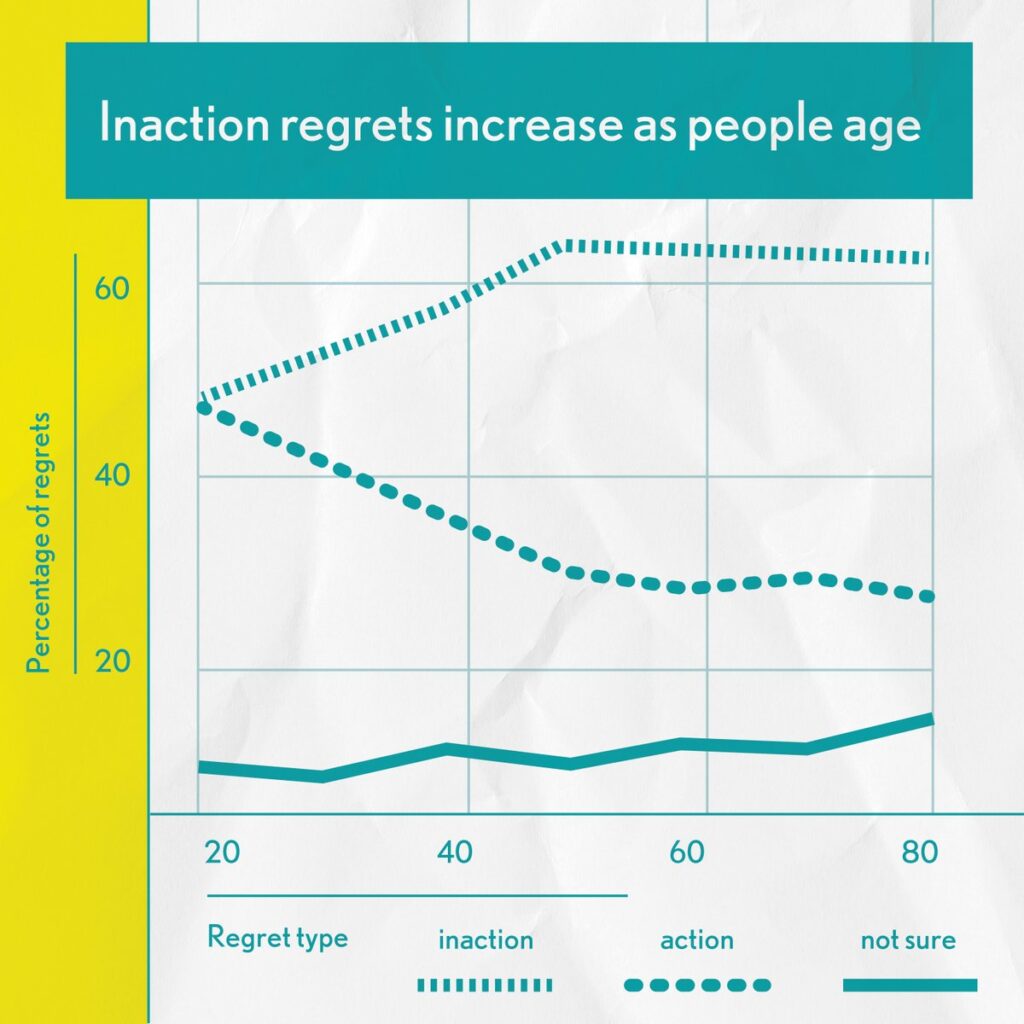
Regret: Thinking you have plenty of time, when in reality things go by astonishingly quickly. (Pillemer, 2012)
“Time is of the essence: Live as though life is short—because it is. The point is not to be depressed by this knowledge but to act on it, making sure to do important things now. The older the respondent, the more likely they were to say that life goes by astonishingly quickly. Said one elder: ‘I wish I’d learned that in my thirties instead of in my sixties!’” -Karl Pillemer, “Top 10 Lessons for Living from the Wisest Americans”
Regret: Not taking advantage of opportunities that come along. (Gulati, 2012; Pillemer, 2012)
Maybe it was the lateral move to a different department you turned down because it felt risky. The speaking invitation you declined out of imposter syndrome. Or the chance to lead a high-visibility project you passed on because you didn’t feel ready yet.
“I regret not having the courage to be more bold earlier in my career and caring too much what other people thought of me.” -South-African woman, age 33 (Pink, 2022)
More Career Regrets
The above regrets are the most common ones, according to the research. But there are other important regrets as well. For example:
- Not asking for a raise or promotion. According to a survey of 1,000 workers in four countries, 60% of workers regret not asking for a pay increase, 51% regret not asking for a promotion, and 58% regret not negotiating their salary when they first took a job. (O’Neill, 2025)
- Not building a professional network sooner.
- Not investing in professional development and continuous learning.
- Not speaking up or advocating for yourself (e.g., not sharing your accomplishments, needs, concerns, or ideas, which can lead to getting overlooked for promotions or opportunities).
- Going it alone and not seeking mentorship or guidance.
- Staying too long with one employer and forgoing chances to accelerate growth by moving to another organization(s).
The Challenges of Career Crafting
This research on the most common career regrets may sound straightforward, but let’s be honest: these matters of career crafting and change are far from easy in many cases.
You may be consumed by personal and professional obligations, making it hard to step out of the grind and work on change. The “switching costs” of career change can be high. Your identity can be wrapped up in your current work or profession.
Perhaps you’re risk-averse by nature. You can get trapped by “analysis paralysis.” Do you think it’s too late to make a change now? You may feel overloaded by options and not clear on what to do next. Or you may lack confidence to make desired changes.
All understandable. But keep in mind that work takes up such a big part of your life. Isn’t it worth crafting your life and work intentionally—and avoiding as many of these career regrets as you can?
This research on the most common career regrets can be catalytic, but only if you pay attention to it and heed its warnings. Is the regret about a mistake you’ve made, or really about something you haven’t lived into? Yet.
Sure, these career regrets can be ominous. But they can also become a blueprint for your next breakthrough.
Wishing you well with it. Let me know if I can help.
–Gregg
Tools for You
- Traps Test (Common Traps of Living) to help you identify what’s getting in the way of your happiness and quality of life.
- Quality of Life Assessment so you can discover your strongest areas and the areas that need work, then act accordingly.
- Crafting Your Life & Work (my signature online course) to help you design your next chapter and create a life you love.
Related Resources
- “Rating Your Job: A Work Satisfaction Checkup”
- “Time to Check the Path You’re On?”
- “Golden Handcuffs—Stuck in a Job You Don’t Like?”
- “Are You Trapped by Success?”
- “Why We Stay in Bad Jobs Too Long”
- “The Perils of ‘Climbing Mode’ in Our Career”
- “How Inertia Keeps Us from Making Needed Changes”
- “The Trap of Thinking It’s Too Late for Big Things in Our Lives”
- “Is Your Identity Too Wrapped Up in Your Work?”
- “The Trap of Deferring Dreams and Postponing Happiness”
- “The Trap of Caring Too Much about What Other People Think”
- “The Trap of Living Someone Else’s Life”
- “Tired of Settling? How to Light Your Life and Work on Fire”
- Gregg Vanourek, “Life Entrepreneurship” TEDx talk video
- Karl Pillemer, 30 Lessons for Living: Tried and True Advice from the Wisest Americans (Avery, 2012).
- Dan Pink, The Power of Regret: How Looking Backward Makes Us Move (Riverhead Books, 2022).
- Paul Tieger, Barbara Barron, and Kelly Tieger, Do What You Are: Discover the Perfect Career for You through the Secrets of Personality Type (Little, Brown and Company, 2013).
- Bronnie Ware, The Top Five Regrets of the Dying (Hay House, 2019).
- Budjanovcanin, A., & Woodrow, C. (2022). Regretting your occupation constructively: A qualitative study of career choice and occupational regret. Journal of Vocational Behavior, 136, 103743.
Postscript: Inspirations on Career Regrets
- “Twenty years from now you will be more disappointed by the things you didn’t do than by the ones you did do. So throw off the bowlines. Sail away from the safe harbor. Catch the trade winds in your sails. Explore. Dream. Discover.” -Sarah Frances Brown (often misattributed to Mark Twain)
- “Ten years from now, what will you regret never having tried?” -Alan Webber, Rules of Thumb
- “…the secret of career satisfaction lies in doing what you enjoy most. A few lucky people discover this secret early in life, but most of us are caught in a kind of psychological wrestling match, torn between what we think we can do, what we (or others) feel we ought to do, and what we think we want to do. Our advice? Concentrate instead on who you are, and the rest will fall into place.” -Paul D. Tieger, Barbara Barron, and Kelly Tieger, Do What You Are
References
-Daniel Gulati, “The Top Five Career Regrets,” Harvard Business Review, December 14, 2012.
-Heather O’Neill, “Resume Now’s International Survey Finds 66% of Workers Suffer From Career Regrets,” ResumeNow.com, January 8, 2025. Another data point: When more than 29,000 people were asked this in a survey–“If you could do it all over again, would you choose the same career you’re in now?”–59 percent said no. Source: “Job Happiness Poll: Most Americans Wish They Could Hit Reset Button on Their Careers,” Parade, August 31, 2012, citing the Parade/Yahoo! Finance Job Happiness Survey.
-Karl Pillemer, 30 Lessons for Living: Tried and True Advice from the Wisest Americans (Avery, 2012). Dr. Pillemer is a gerontologist and professor at Cornell University who studies aging and conducts research on older adults’ life experiences and wisdom.
-Dan Pink, The Power of Regret: How Looking Backward Makes Us Move Forward (Riverhead Books, 2022). For this book, author Dan Pink surveyed 4,489 Americans across ages, races, genders, and socioeconomic levels. He also launched a companion website that collected open-ended regrets from more than 15,000 people in 105 countries. Pink found that nearly all regrets fall into four categories:
- foundation regrets: wishing you had made better decisions early on that would have set you up for success later, like saving money, staying in school, or taking care of your health.
- boldness regrets: wishing you had taken a chance or spoken up when you had the opportunity, instead of playing it safe out of fear.
- moral regrets: wishing you had done the right thing in a moment when you chose the easier, selfish, or dishonest path instead.
- connection regrets: wishing you had reached out to maintain or repair a relationship that drifted apart or ended, leaving things unsaid or unresolved.
-Paul D. Tieger, Barbara Barron, and Kelly Tieger, Do What You Are: Discover the Perfect Career for You through the Secrets of Personality Type (Little, Brown and Company, 2013).
-Bronnie Ware, The Top Five Regrets of the Dying (Hay House, 2019). Bronnie Ware is an Australian palliative care nurse who documented the common regrets expressed by patients in their final weeks of life, which she compiled into this book.
* To help avoid these kinds of regrets, Jeff Bezos, founder and CEO of Amazon, recommends the following: When facing a major decision, imagine yourself at age 80 looking back on your life and ask which choice would give you fewer regrets.

+++++++++++++++++
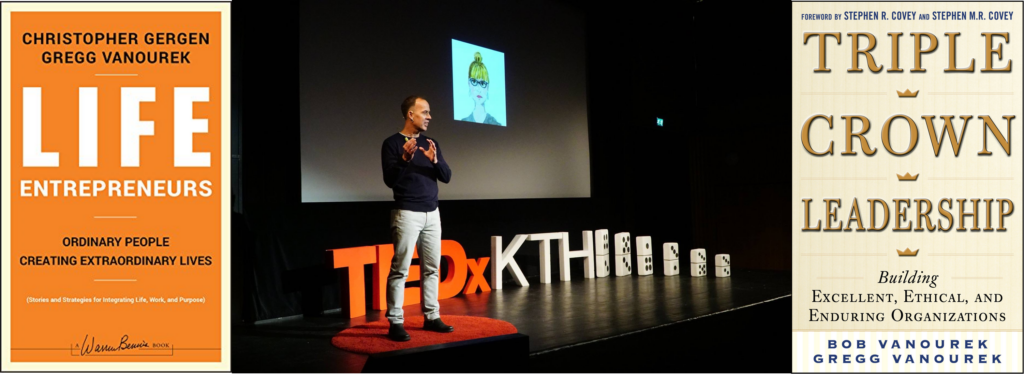
Gregg Vanourek is a writer, teacher, and TEDx speaker on personal development and leadership. He is co-author of three books, including LIFE Entrepreneurs: Ordinary People Creating Extraordinary Lives (a manifesto for living with purpose and passion) and Triple Crown Leadership: Building Excellent, Ethical, and Enduring Organizations (a winner of the International Book Awards). He has worked for market-leading ventures and given talks or workshops in 8 countries. Check out his Crafting Your Life & Work online course or get his monthly newsletter. If you found value in this article, please forward it to a friend. Every little bit helps!