
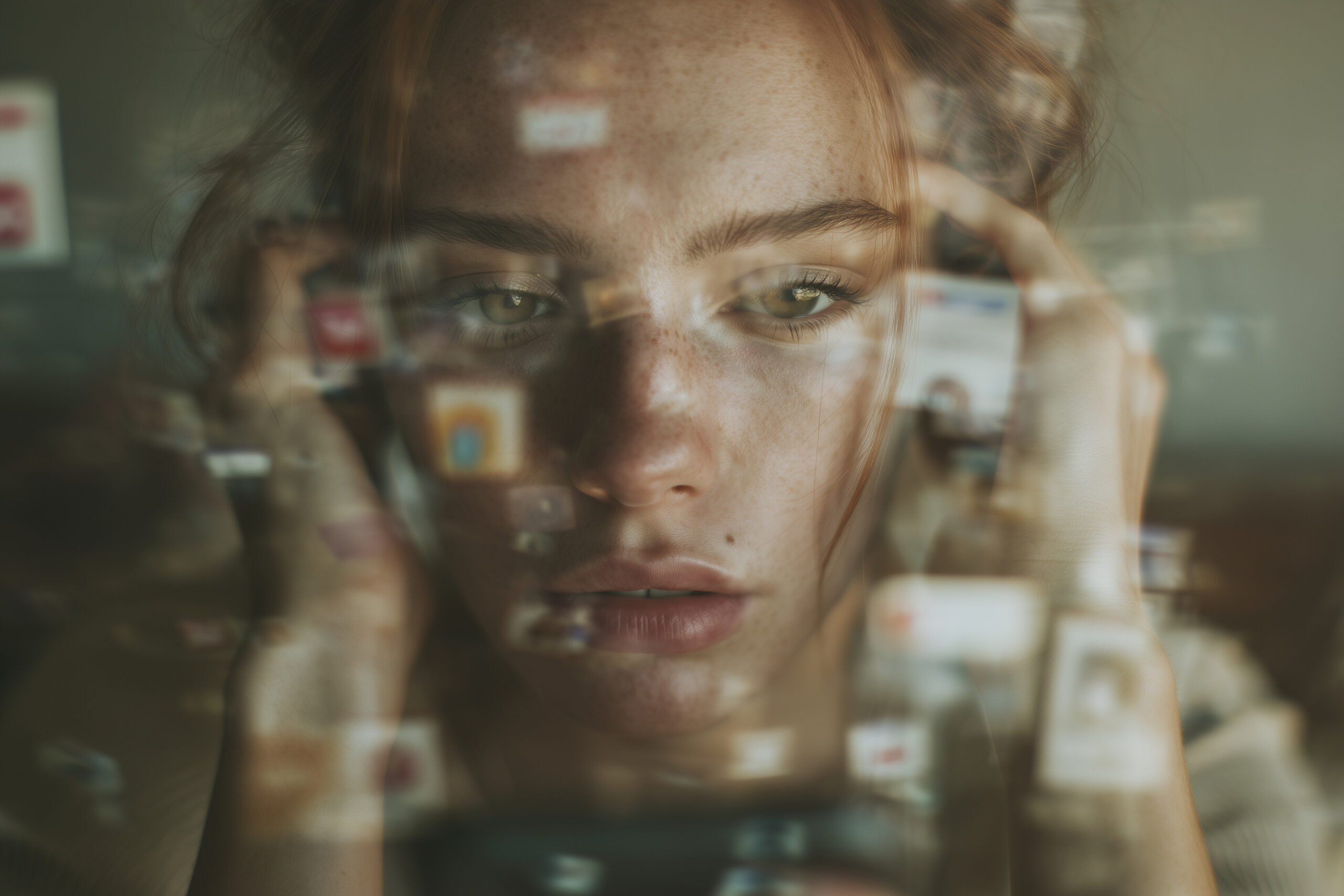
What a SAD way to live: letting the digital overload of Screens, Algorithms, and Devices take over so much of our lives. If you spend an average of just two hours a day on your device—a conservative estimate for most—you will have given up a staggering 10 years of your waking life to screens by the time you reach age 80. Many people spend double that. That’s 20 years. (1)
Yes, our devices are amazing, but are they worth giving up so much of our time on the planet?
Clearly, there are tradeoffs. Technology is great because you can text your spouse about the grocery list, connect with friends, and buy things at the click of a button. But what about binge-watching, doom-scrolling, validation seeking, comparison scrolling, Pavlovian notification checking, clickbait chasing, impulse buying, and rabbit-hole falling? How much time have you spent on those?
“Some days, we just need to turn the quiet up.”
-Dr. SunWolf, Professor, Santa Clara University
And how dependent are you on your phone? These days, there’s even a term for it: “nomophobia” (when you fear being detached from mobile phone connectivity, i.e., “NO MObile PHone PhoBIA”).
Think about how you feel when you’ve been on your device for a while. Frazzled. Dull. Lifeless. Mopey. Exhausted. In a nutshell, probably worse.
The Value of Screens and Devices
You can of course derive great value from technology and devices. You might use educational apps to learn a new language. Take online courses to advance your career. Attend virtual meetings to save time. Use video calls to stay close with distant relatives. Use health apps to track wellness goals. All good.
But there are also many risks and downsides to using screens and devices so often.
The Downsides of Digital Overload with Screens and Devices
Mounting research connects heavy screen use with a host of potential harmful consequences, including:
- addiction
- increased anxiety and depression
- reduced attention spans
- reduced cognitive function
- eye strain
- trouble maintaining focus
- exposure to disturbing or harmful content
- reduced time outdoors
- sedentary behavior
- sleep disruption
- social isolation

What About Algorithms?
As with screens and devices, so it goes with algorithms. An algorithm is essentially a set of invisible instructions that tells a computer what to do or show you next, based on your behavior (clicks, view time, etc.). When YouTube cues up a string of related videos after you watch one, that’s the algorithm at work.
The algorithm isn’t designed to serve your best interests. It’s designed to keep your eyes on the screen, because more time on the platform means more advertising revenue for them. In other words, they’re selling your attention to advertisers. They’re monitoring and monetizing you.
“Imagine walking into a control room with a bunch of people hunched over a desk with little dials, and that that control room will shape the thoughts and feelings of a billion people. This might sound like science fiction, but this actually exists right now, today…. Right now it’s as if all of our technology is basically only asking our lizard brain what’s the best way to impulsively get you to do the next tiniest thing with your time, instead of asking: in your life, what would be time well spent for you?” -Tristan Harris, Executive Director, Center for Humane Technology
The Benefits of Algorithms
Of course, there are many benefits that can come from algorithms. For example, you can use them to do (or help with) many things, including:
- solving crimes
- analyzing huge data sets (e.g., monitoring power grids for failures, detecting early signs of cancer in medical imaging)
- automating boring or repetitive tasks
- identifying students at risk of dropping out of school
- developing vaccines
The possibilities are remarkable. But there are also dangers that are easy to miss.
The Insidious Effects of Algorithms on Our Lives
In his book, Against the Machine: On the Unmaking of Humanity, English writer Paul Kingsnorth notes that even the words we use to describe the tech we use every day (e.g., “the web,” “the net”) are revealing: “These are things designed to trap prey.” They trap us with the promise of dopamine hits from “likes” and the hope of finding that super-cute cat video.
Author Cathy O’Neil calls a certain class of algorithms “weapons of math destruction”:
“The math-powered applications powering the data economy were based on choices made by fallible human beings. Some of these choices were no doubt made with the best intentions. Nevertheless, many of these models encoded human prejudice, misunderstanding, and bias into the software systems that increasingly managed our lives. Like gods, these mathematical models were opaque, their workings invisible to all but the highest priests in their domain: mathematicians and computer scientists…. I came up with a name for these harmful kinds of models: Weapons of Math Destruction.” -Cathy O’Neil, Weapons of Math Destruction: How Big Data Increases Inequality and Threatens Democracy
Here are some ways that algorithms can be harmful:
- amplification of bias and discrimination (e.g., in criminal sentencing, hiring/screening job candidates, housing/renting, insurance rates, loan applications, university admissions)
- manipulation of consumers and voters (e.g., giving people only information that supports their preferences or preconceptions, or taking people down “rabbit holes” with conspiracy theories)
- spreading of misinformation and false narratives
- intensification of polarization
- erosion of privacy
- distortion of your self-image (e.g., body shape) (2)
Another issue with algorithms is that they’re often mysterious. Sometimes even their programmers don’t fully understand them.
Though they’re very effective at many things, algorithms often miss the nuances associated with complex endeavors, leading to unforeseen consequences. Consider when they’re involved with decisions about teaching students or caring for sick patients.
What’s more, the errors associated with (or caused by) algorithms are often magnified due to the scale that technology facilitates. According to journalist and author Hilke Schellmann, “One biased human hiring manager can harm a lot of people in a year, and that’s not great. But an algorithm that is maybe used in all incoming applications at a large company… that could harm hundreds of thousands of applicants.”
What to Do About Digital Overload
What does this mean for you? How can you derive the benefits of technology without succumbing to digital overload? Here are five things you can do to reduce the damage caused by excessive use of screens, algorithms, and devices:
1. Set boundaries around your device use. Example: no screens for the first and last hour of each day. This would give you time to ease into your morning with coffee and a book instead of emails, and wind down at night without the blue light and mental stimulation that can interfere with sleep. Also, track your average daily device time and take action when it’s ballooning. (3)
2. Create screen-free zones in your home. Example: keep devices out of the bedroom so it remains a space for rest and connection. Establish a no-phones-at-the-table rule so meals become a time for talking instead of scrolling.
3. Calendarize offline activities. If screen time is preventing you from engaging in hobbies, reading, exercising, cooking, meditating, or spending time outdoors, develop a system to help turn the tide. Example: block out an evening each week for your hobby. Take a short walk after lunch every day. Set aside Saturday mornings for reading with your coffee.
There are two keys to this approach. The first is to develop habits and routines that make it easier to do things you enjoy instead of defaulting to passive digital consumption. The second is to get outside much more. Journalist and author Richard Louv laments what he calls “nature deficit-disorder,” which he defines as “a diminished ability to find meaning in the life that surrounds us.” He explains that it’s not a medical diagnosis; rather, it’s a simple way to describe the growing gap between us and nature.
“There’s no WiFi in the forest, but you’ll find a better connection.”
-author unknown
4. Turn off notifications. Frequent pings and buzzes fragment your attention and create unnecessary urgency around trivial things. Action: disable all notifications except calls and texts from your “favorites” list, so you’re not interrupted by every new email or social media like while you’re working on a project or having dinner with friends. (And just because you see a notification doesn’t mean you need to address it now.)
5. Create a digital detox routine. Example: designate every Sunday as a screen-free day to recharge and reconnect with loved ones and the natural world.
Conclusion: Defeating Digital Overload
Sometimes our use of technology masks deeper issues. Are you using tech to avoid problems at home or to numb your pain? Do you resort to screens and devices instead of developing a rich inner life?
It’s now painfully clear that even though we’re deriving great value from these products, we’re also paying dearly for them in terms of our precious time, wellbeing, and sanity.
How about you? Is it time to take your life back from the “SAD three” (Screens, Algorithms, Devices) so you can spend more time living, breathing, connecting, serving, loving, and thriving? I suspect you know the answer. The key is keeping your focus on what really matters—and counting the cost of trading it away for the digital abyss.
Here’s to living well and deploying our devices to serve our own needs and not vice versa.
–Gregg
Tools for You
- Traps Test (Common Traps of Living) to help you identify what’s getting in the way of your happiness and quality of life.
- Quality of Life Assessment so you can discover your strongest areas and the areas that need work, then act accordingly.
- Crafting Your Life & Work (my signature online course) to help you design your next chapter and create a life you love.
Related Articles & Resources
- “Are We Numbing Our Lives Away?”
- “The Problem with Not Having Boundaries”
- “The Problem with Neglecting Our Inner Life”
- “A Guide to Life-Boosting Activities”
- “The Benefits of Nature and Getting Outside”
- Center for Humane Technology
- Paul Kingsnorth, Against the Machine: On the Unmaking of Humanity (Thesis, 2025)
- Cathy O’Neil, Weapons of Math Destruction: How Big Data Increases Inequality and Threatens Democracy (Crown, 2017)
- Hilke Schellmann, The Algorithm: How AI Decides Who Gets Hired, Monitored, Promoted, and Fired and Why We Need to Fight Back Now (Grand Central Publishing, 2024)
- Devi KA, Singh SK. The hazards of excessive screen time: Impacts on physical health, mental health, and overall well-being. J Educ Health Promot. 2023 Nov 27;12:413.
Postscript: Quotations on Digital Overload and Technology
- “Passive screen time is like eating sugar but for your brain. It ‘tastes’ good, and you want it now, but you’re not actually feeding yourself. You’re not giving your brain any nutrition.” -Maris Loeffler, family and marriage therapist
- “…carving out time to turn off your devices, to disconnect from the wired world and engage with the real people who are all around you, is one of the best gifts you can give yourself and the people you love.” -Alan Brown, entrepreneur
- “…we are not slaves to these devices unless we allow ourselves to become so. To me, the trick is to put yourself in charge of your screens instead of allowing your screens to be in charge of you.” -Dr. Edward Hallowell, M.D., child and adult psychiatrist
- “Unlike television, nature does not steal time; it amplifies it. Nature offers healing for a child living in a destructive family or neighborhood.” -Richard Louv, Last Child in the Woods: Saving Our Children from Nature-Deficit Disorder
- “In today’s mesmerizing digital landscape, our attention is madly sought after. Algorithms are ingeniously designed to keep us hooked like addicts by feeding us mainlines tailored to hold us captive…” -Sol Luckman, Get Out of Here Alive
- “Welcome to the age of AI, where algorithms grow bigger, and minds get smaller.” -Abhijit Naskar, The Humanitarian Dictator
- “A new normal is establishing itself in which an undeclared or invisible war is fought entirely through algorithms, narratives, and manipulated media.” -Roger Spitz, The Definitive Guide to Thriving on Disruption: Volume I
- “The screen is both our main source of distraction from reality and the interface by which we are directed into the coming post-human reality of the Machine…. What comes through these screens bleeds out any connection with the divine, with nature or with the fullness of humanity.… human culture is in the process of being consumed by the Machine. Something organic is being superseded by something planned; something natural by something technological. This is the anticulture of the Machine, and it supersedes and replaces the values on which older societies the world over are based.” -Paul Kingsnorth, Against the Machine: On the Unmaking of Humanity
References
(1) This calculation assumes an average of 16 waking hours per day (accounting for 8 hours of sleep). While most people do not begin significant device usage in their childhood years, this figure accounts for that by being conservative in terms of average daily usage.
(2) “For many girls, this rewiring of their self-image, this pressure to alter their appearance, happened without them realizing it. It was gradual. Subtle. Drip-fed.” -Freya India, author
(3) This is especially important for children, According to the National Institutes of Health, “Health experts say screen time at home should be limited to two hours or less a day.” Potential harm from digital overload to children includes negative academic, behavioral, physical/mental health, and social effects.

+++++++++++++++++
Gregg Vanourek is a writer, teacher, and TEDx speaker on personal development and leadership. He is co-author of three books, including LIFE Entrepreneurs: Ordinary People Creating Extraordinary Lives (a manifesto for living with purpose and passion) and Triple Crown Leadership: Building Excellent, Ethical, and Enduring Organizations (a winner of the International Book Awards). He has worked for market-leading ventures and given talks or workshops in 8 countries. Check out his Crafting Your Life & Work online course or get his monthly newsletter. If you found value in this article, please forward it to a friend. Every little bit helps!