

Article Summary:
What self-deception is, including examples and signs of it, where it comes from, its high costs (as well as some benefits), how it degrades our leadership, and what to do about it.
+++
We all do it. We engage in self-deception—hiding the truth from ourselves about our true feelings, motives, or circumstances. When we’re deceiving ourselves, we’re denying evidence, logic, or reality and rationalizing choices or behaviors to serve a false narrative. We’re not seeing or viewing things accurately. Our self-deception can be conscious or unconscious, controlled or automatic, acute or chronic.
“You can fool yourself, you know. You’d think it’s impossible, but it turns out it’s the easiest thing of all.”
-Jodi Picoult, Vanishing Acts
Self-deception is often a defense mechanism used for self-protection, and it can be used for self-enhancement. But it often becomes a form of self-sabotage and betrayal because it denies reality. When we deceive ourselves, we become our own enemy posing as a friend. Self-deception can involve denial of hard truths, minimization of painful matters, or projection of fault onto others.
“We do not deal much in fact when we are contemplating ourselves.”
-Mark Twain
Examples of Self-Deception in Action
Self-deception is tricky because we’re often not aware of it when we’re doing it. (That’s how good we are at it.)
But if we took the time to look for it earnestly, we’d likely find many examples of it in our lives. For example, we may be pretending we still like a job or career when we don’t anymore or concealing our disappointment in ourselves for giving up on our dreams and goals.
Other examples of self-deception in action:
- a dreamer who keeps postponing big plans with excuses about not having enough time or it not being the right time to start
- a young single who keeps reading way too much into casual acts by a romantic interest
- a spouse who keeps focusing on his partner’s faults and ignoring his own issues
- a worker who spins self-serving tales about why others are getting raises and promotions
- a person whose wishful thinking about credit-card debt or college loans starts to cause big problems
- a spouse who looks the other way when there’s clear evidence of infidelity or violence, or a spouse who rationalizes his or her own deception
- an addict who believes her addictions are under control*
What are we hiding from ourselves?
What truths are we running from?

Five Signs of Self-Deception
Though it can be hard to detect, there are signs of self-deception in action. For example, we’re probably deceiving ourselves when we:
- keep making excuses for ourselves or others
- can’t accept responsibility for things
- keep blaming others
- keep avoiding unpleasant realities
- feel defensive or threatened when people challenge us
Our self-deception usually comes with a fair amount of discomfort and anxiety, in part because of the cognitive dissonance we experience when we do it. (Cognitive dissonance is the mental discomfort we feel when we hold conflict believes, values, or attitudes or when there’s a disconnect between what we believe and how we behave.)
“The first principle is that you must not fool yourself—and you are the easiest person to fool.”
-Richard Feynman, theoretical physicist
Where Our Self-Deception Comes From
Where does our self-deception come from? It has many potential origins. For example, it can come from:
- our upbringing or culture programming (seeing instances of self-deception from our parents or others)
- lacking confidence (lying to ourselves to compensate for insecurity)
- fear of judgment from others (deceiving ourselves with stories and rationalizations that prevent us from facing that harsh music)
- wanting to please others (rationalizing the downplaying of our own needs so we can stay in their good graces)
- wanting to impress others (kidding ourselves into believing we’re better than we are while downplaying our flaws)
- wanting to avoid painful thoughts or experiences (e.g., after we’ve endured hardship or trauma)
- preferring the convenience of an easy delusion over a hard truth
We may engage in self-deception out of anxiety, neediness, desire, or other powerful emotions. As humans, we have emotional attachments to many beliefs, some of which may be irrational. Our self-deception can serve as a coping mechanism for strong feelings of shame about our actions, feelings, or habits.
On the plus side, self-deception can make us feel better about ourselves and help us maintain our confidence in the face of challenges and setbacks. But it can also help us avoid taking responsibility for our actions.
The High Costs of Self-Deception
Self-deception isn’t only a matter of mental games we play. Unfortunately, its consequences are all too real. For example, self-deception can:
- make it harder to grow and develop because we’re not seeing our flaws clearly
- detract from our mental and emotional clarity
- cause us to lose sight of who we really are and what’s real because we’ve been deceiving ourselves so long
- aggravate our worry and anxiety because it leads to letting things deteriorate further
- lead to numbing behaviors like binge-watching, overwork, drinking, overeating, and more
- make us feel like a fraud
- make us feel exhausted from all the mental gymnastics of lying to ourselves and trying to cover it up
- lead to inaccurate judgments and poor decisions, since we’re going off of faulty data
- make us feel shame and guilt
- lead us to deceiving others often, not just ourselves
- weaken our relationships
- diminish our power and agency in directing our lives effectively
- keep us trapped in bad or even dangerous habits, situations, or relationships
- become a vicious circle and way of life, a bad habit pattern that keeps harming us in many areas
“Reality denied comes back to haunt.”
-Philip K. Dick, writer
In short, it can become a downward spiral leading to further self-deception and a host of other problems in our lives, many of which are quite serious. And the longer we do it, the more we believe the lies.
When we deceive ourselves, we start losing trust in ourselves. We no longer accept and trust ourselves or feel that we have a sense of control in our life.
“Some people spend their entire life in self-deception or denial,
but the situations or circumstances that we are denying will usually get worse with time.”
-Terri Cole, Licensed Clinical Social Worker
According to researchers, when we’re not authentic, it makes us feel immoral and impure. According to Harvard Business School Professor Francesca Gino and her colleagues in their paper, “The Moral Value of Authenticity”:
“When participants recalled a time that they behaved inauthentically, rather than authentically, they felt more impure and less moral…. When people behave in ways that are inconsistent with their own sense of self, they feel morally tainted and engage in behaviors to compensate for these feelings.”
Are There Benefits of Self-Deception?
With all these costs associated with self-deception, it begs the question of why it exists at all. It turns out that there are some benefits of self-deception—in the right circumstances and amount. For example, according to some researchers, self-deception may:
- help protect us as a coping mechanism or even survival tactic against painful or even intolerable emotions (e.g., after we’ve experienced trauma)
- help us with our motivation when facing challenging situations
- reduce cognitive load (the amount of information we can hold at one time in our brain’s working memory) in some circumstances, thus helping to conserve cognitive resources**
In addition, in a 1979 study, researchers noted that depressed people tend to assess their strong and weak points and recall negative criticisms more realistically (with less self-deception), while nondepressed people typically view themselves favorably and underestimate how often others judge them unfavorably. It makes sense that, if self-deception leads to more favorable self-assessments, that can lead to positive feelings that contribute to wellbeing.
In the end, though, many acts of self-deception will end up harming us in the long run if we let them continue.
“Everyone self-deceives, but that doesn’t make it harmless. At high levels, it is associated with poor mental health. At moderate levels, it can temporarily protect the self-deceiver from bad feelings but still presents a barrier to the deep well-being that comes from living with integrity. To be really happy, we must learn to be completely honest with ourselves.” -Arthur Brooks, “Quit Lying to Yourself,” The Atlantic

How Self-Deception Affects Our Leadership
In the workplace, self-deception can inhibit our effectiveness and degrade our leadership. For example, it can:
- limit our growth and potential since we’re not facing up to our weaknesses
- prevent us from seeing beyond our own opinions and priorities
- lead to unethical decisions and behaviors, including justifying poor behavior, such as intimidation, harassment, or bullying
- inhibit our leadership effectiveness and thus organizational productivity
- lead to crises because we’re in denial about problems and our own role in them
“If you want to be successful, you must respect one rule: Never lie to yourself!”
-Paolo Coelho, Brazilian novelist
Evolutionary biologist Robert Trivers has developed a theory of “self-deception in the service of deception”—a dangerous loop in which people like deceptive and toxic leaders can be so good at deceiving themselves about things that it makes them more effective in deceiving others, because they don’t show the telltale signs of lying. They’re so good at lying to themselves that it makes them adept at lying to others and remaining somehow credible to them.
“…if a liar can deceive himself into believing he is telling the truth, he will be far more effective in convincing others.”
-Daniel Kriegman, Robert Trivers, and Malcom Slavin
Trivers calls this “hiding the truth from yourself to hide it more deeply from others,” and he notes that it can lead to “predatory deception” and exploitation. (It’s noteworthy that self-deception plays a major role in medical conditions such as narcissistic personality disorder and borderline personality disorder.)
It doesn’t stop there. In the Arbinger Institute’s book, Leadership and Self-Deception, the authors write, “Whether at work or at home, self-deception obscures the truth about ourselves, corrupts our view of others and our circumstances, and inhibits our ability to make wise and helpful decisions…. Of all the problems in organizations, self-deception is the most common, and the most damaging.”
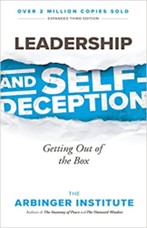
The authors point out that that self-deception can lead to treating people like objects because we view their needs as less important than our own, inflating our own virtues and other people’s faults, and a vicious cycle of mutual blame and mistreatment.
They also point out that it’s contagious. The more self-deception occurs, the more it will spread to others.
So what can leaders do to mitigate the negative effects of self-deception? A few things: First, be wary of praise, noting that most people are suckers for praise and that it can distort our perceptions and inflate our ego. Second, be open to tough feedback, especially when we find ourselves resisting it. Third, solicit feedback proactively and regularly, including structured and confidential 360-degree feedback.
“We’re all liars…Entrepreneurs are particularly good at lying to themselves.
Entrepreneurs are the most delusional of all.”
-Alistair Croll and Benjamin Yoskovitz, Lean Analytics
What to Do About It
Though self-deception is a common and vexing problem, there are many things we can do to address it:
- be on the lookout for examples of it in our own life so we can begin to address it
- commit to being fully honest with ourselves and “fierce with reality,” as educator Parker Palmer advises
- engage in regular self-reflection and build self-awareness so that we have a clear sense of who we are, what motivates us, and what trips us up
- work to understand the root causes that led us to start deceiving ourselves
- reflect on our fears and where they come from and how they show up in our lives
- work on our self-acceptance, especially on accepting our flaws
- develop our confidence so that we truly believe that we’re enough (and thus don’t need to lie to ourselves)
- remain open to changing our mind about things as we obtain new information or perspectives
- seek help with being honest with ourselves from trusted friends and colleagues or a coach or mentor
- when we find ourselves blaming others, shift our focus from the faults of others to ideas about how we can help them
- journal openly and freely, with stream-of-consciousness observations and reflections (the privacy of our journaling may help us be more fully honest with ourselves)
Conclusion: The Benefits of Being Totally Honest with Ourselves
The work of moving from self-deception to fierce acceptance of truth and reality may not be easy, but it’s well worth it. In the process, we’ll start trusting ourselves again and develop our self-acceptance as well as our authenticity.
Meanwhile, we can develop our emotional intelligence, connect more genuinely with others, set a good example by being honest and self-aware, and get better results in our chosen endeavors.
Reflection Questions
- To what extent are you engaging in self-deception—and in which areas?
- How is it holding you back?
- What will you do about it, starting today?
Tools for You
- Traps Test (Common Traps of Living) to help you identify what’s getting in the way of your happiness and quality of life
- Quality of Life Assessment to help you discover your strongest areas and the areas that need work and then act accordingly
- Personal Values Exercise to help you clarify what’s most important to you

Related Articles and Traps
- “Why Self-Awareness Is So Important–And How to Develop It“
- “The Mental Prisons We Build for Ourselves”
- “Breaking the ‘Trance of Unworthiness’”
- “The Conformity Trap”
- “The Perfectionism Trap”
- “Are You Pretending to Be Something You’re Not?”
- “What Are You Avoiding?”
- “Time to Check the Path You’re On?“
- “The Trap of Losing Yourself”
- “Neglecting Our Inner Life”
- “The Trap of Caring Too Much about What Other People Think”
- “The Trap of Not Moving On”
- “Getting Good at Overcoming Fear”
- Zoe Chance and Michael Norton, “The what and why of self-deception,” Current Opinion in Psychology 2015, 6: 104-107.
Appendix: Self-Deception and Cognitive Biases
Research from psychologists Daniel Kahneman, Amos Tversky, and many others has shown that we have many cognitive biases—systematic errors in thinking that influence how we make decisions—which can lead to distorted perceptions and faulty judgments. Cognitive biases manifest automatically and unconsciously over a wide range of our reasoning. Researchers have identified at least 58 cognitive biases and heuristics (the process by which we use mental shortcuts to arrive at decisions).
Examples of cognitive biases related to self-deception include:
- Confirmation bias: our tendency to favor information that confirms our beliefs or hypotheses.
- Overconfidence bias: our tendency to overestimate our abilities.
- Illusion of control: overestimating our ability to control events.
- Optimism bias: our tendency to overestimate favorable outcomes.
- Planning fallacy: our tendency to underestimate the time, costs, and risks of future actions and to overestimate their benefits.
- Positive illusion: our unrealistically favorable attitudes towards ourselves or those close to us.
- Competition neglect: ignoring the likelihood of other entrepreneurs or competitors undertaking the same venture.
- “Dunning–Kruger effect”: when people with low ability at a certain task overestimate their ability.
According to researchers, we tend to overestimate our positive attributes (e.g., intelligence, competence, attractiveness) and underestimate our negative ones (e.g., character flaws, mistakes). Some telling examples of self-deception and biases in action:
- The vast majority of us consider ourselves above average.
- Only 2% of high school seniors believe their leadership skills are below average; 70% report they’re above average.
- 25% of people believe they’re in the top 1% in their ability to get along with others.
- 94% of college professors say they’re doing above-average work.
- For certain types of questions, answers that people rate as “99% certain” turn out to be wrong 40% of the time.
Sources: Chip and Dan Heath, Switch (Crown Business, 2010) and Adam Grant, Originals: How Non-Conformists Move the World (Penguin, 2016). Peter Borkenau and Anette Liebler, “Convergence of Stranger Ratings of Personality and Intelligence with Self-Ratings, Partner Ratings, and Measured Intelligence,” Journal of Personality and Social Psychology 65 (1993), 546-553. David Dunning et al., “Flawed Self-Assessment,” Psychological Science in the Public Interest 5 (2004).
Postscript: Inspirations on Avoiding Self-Deception
- “All humans have self-deceptions.” -Harry C. Triandis, professor emeritus, University of Illinois in Champaign-Urbana
- “To thine own self be true…. Thou canst not then be false to any man.” -Polonius to his son Laertes in “Hamlet” by William Shakespeare
- “The ingenuity of self-deception is inexhaustible.” -Hannah More
- “No one wants to be seen as a liar. Liars are considered untrustworthy at best and immoral at worst. And yet, we are perfectly content to lie to ourselves all the time.” -Arthur Brooks, “Quit Lying to Yourself,” The Atlantic
- “Dishonesty is a trait that most of us have no problem pointing out in others. We feel a sense of anger, disgust, and mistrust towards those who try to deceive us…. Secretly, it feels good to point the finger at others because it makes us feel morally righteous. But here’s the truth: at the end of the day, most of us fail to see that we also lie—to ourselves—frequently…. Deception is such a despicable quality that we would rather disown it than face it honestly.” -Aletheia
- “Being entirely honest with oneself is a good exercise.” -Sigmund Freud
- “If I was lying on my deathbed and I had kept this secret and never ever did anything about it, I would be lying there saying, ‘You just blew your entire life. You never dealt with yourself,’ and I don’t want that to happen.” -Caitlyn Jenner
- “…the ultimate self-help strategy, the one practice that could end all your suffering and get you all the way to happiness. Stop lying.” -Martha Beck in The Way of Integrity
- “Our lives only improve when we are willing to take chances and the first and most difficult risk we can take is to be honest with ourselves.” -Walter Anderson
- “Above all, don’t lie to yourself. The man who lies to himself and listens to his own lie comes to a point that he cannot distinguish the truth within him, or around him, and so loses all respect for himself and for others. And having no respect he ceases to love.” -Fyodor Dostoevsky, The Brothers Karamazov
- “The lies we tell other people are nothing to the lies we tell ourselves.” -Derek Landy, Death Bringer
- “We all practice self-deception to a degree; no man can handle complete honesty without being cut at each turn. There’s not enough room in a man’s head for sanity alongside each grief, each worry, each terror that he owns. I’m well used to burying such things in a dark cellar and moving on.” -Mark Lawrence, Prince of Fools
- “Life out here is hard. We all try to get through the best way we can. But trust me, there’s not a single person here who isn’t lying to themselves about something.” -Jane Harper, The Lost Man
- “Lying to ourselves is more deeply ingrained than lying to others.” -Fyodor Dostoevsky
- “You can never be true to others, if you keep on lying to yourself.” -Gift Gugu Mona
- “Honesty is the first chapter in the book of wisdom.” -Thomas Jefferson
* Researchers have observed that drug and alcohol addicts exhibit higher scores of self-deception. Martínez-González JM, Vilar López R, Becoña Iglesias E, Verdejo-García A. Self-deception as a mechanism for the maintenance of drug addiction. Psicothema. 2016; 28(1): 13-9.
** “Cognitive and emotional dissonance are difficult to hold. Self-deception allows us to hold onto this sense of coherence, even though it means we leave out some parts of the truth of who we are and live under some form of illusion.” -Ling Lam, PhD, licensed marriage and family therapist

++++++++++++++++++++++++++++++
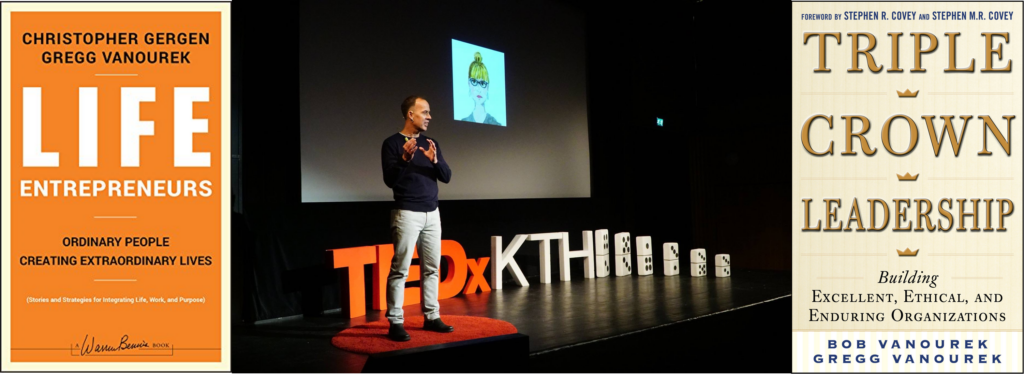
Gregg Vanourek is a writer, teacher, and TEDx speaker on personal development and leadership. He is co-author of three books, including LIFE Entrepreneurs: Ordinary People Creating Extraordinary Lives (a manifesto for living with purpose and passion) and Triple Crown Leadership: Building Excellent, Ethical, and Enduring Organizations (a winner of the International Book Awards). Check out his Crafting Your Life & Work online course or get his monthly newsletter. If you found value in this article, please forward it to a friend. Every little bit helps!