

Article Summary:
Many people spend a huge portion of their lives at work, yet often struggle with bad bosses, unsupportive workplaces, or jobs that leave them drained. This work satisfaction checkup helps you rate your job so you can identify needed changes. If you’re wondering ‘How do I rate my job?’ this checklist can help.
+++
You probably spend much of your life at work. The quality of your work life can deeply affect your mental health, growth, happiness, energy, sense of meaning, and overall life satisfaction.
“Hundreds of studies have shown that job satisfaction and life satisfaction are positively related, and causal:
liking your job causes you to be happier all around.”
-Arthur C. Brooks and Oprah Winfrey, Build the Life You Want:
The Art and Science of Getting Happier
Unfortunately, many people work for bad bosses or labor in lame workplaces. According to Gallup, employee engagement hit a 10-year low in 2024.
“The way we’re working isn’t working.”
-Tony Schwartz, The Way We’re Working Isn’t Working
“Every worker needs to escape the wrong job.”
-Peter Drucker
“Oh, you hate your job? Why didn’t you say so? There’s a support group for that.
It’s called EVERYBODY and they meet at the bar.”
-George Carlin, comedian
Here’s a quick checkup to help you see how things are going with your work—and where some extra attention could make a big difference.
Work Satisfaction Checkup: Rating Your Job
Review the factors below and rate them using the scale provided.
Work Environment
Do you feel safe and supported in your workspace, both physically and psychologically? Are the work site, tools, and resources conducive to your best work? Are you free from hazards, exploitation, bullying, and abuse?
1: Needs Work
2: Doing Fine
3: Thriving
Workload
Do you have a reasonable and manageable workload that allows you to do your work without constant or excessive stress or burnout—and without harming your health and personal life? Are expectations realistic and deadlines achievable? Do you have clear visibility into your obligations and schedule so you can plan effectively?
1: Needs Work
2: Doing Fine
3: Thriving
Compensation*
Are you paid fairly for what you do, taking into account your skill level, responsibilities, peers, industry benchmarks, cost of living in your area, and the value of your contributions? Is the pay structure transparent and predictable, with clear opportunities for increases over time? Does your total compensation—including bonuses, incentives, or other rewards—accurately reflect your impact and results?
1: Needs Work
2: Doing Fine
3: Thriving
Benefits
Are the workplace benefits (health insurance, retirement plans, time off, etc.) sufficient and helpful to your well‐being? Do they support your life beyond work (family, health, rest, etc.)? Are they appropriate for your industry, sector, and geographic area?
1: Needs Work
2: Doing Fine
3: Thriving
Manager
Does your manager treat you fairly and with respect? Do they set clear expectations and communicate effectively? Are they reasonable in their demands and supportive of your growth and wellbeing? Do you feel comfortable bringing up concerns and confident that they’ll listen and respond appropriately?
1: Needs Work
2: Doing Fine
3: Thriving
“Surveys show that one in two people at some point in their careers
have left their job to get away from their managers.”
-Jim Kouzes and Barry Posner, The Leadership Challenge
Flexibility
Do you have flexibility in how, when, or where you work (e.g., scheduling, remote/hybrid options)? Does the job allow you to balance work and personal life? Are you able to adjust your workload or schedule when unexpected demands arise?
1: Needs Work
2: Doing Fine
3: Thriving
Fairness
Are you treated fairly when it comes to expectations, opportunities, and rewards? Are expectations clear? Is decision-making transparent and just? Does the organization avoid discrimination and bias in all forms? Do policies, promotions, and recognition apply consistently across teams and roles?
1: Needs Work
2: Doing Fine
3: Thriving
Engagement
Do you feel invested in your work? Are you energized by your role rather than feeling drained or disengaged? Do you feel connected to your team, your manager, and the organization’s purpose and vision? Are your skills and strengths being put to use effectively?
1: Needs Work
2: Doing Fine
3: Thriving
Autonomy
Do you have enough freedom to decide how you approach your work and set priorities? Are you trusted to make your own decisions on many aspects of your job without excessive oversight? Are you adequately involved in shaping your tasks, methods, or schedule in ways that help you do your best work?
1: Needs Work
2: Doing Fine
3: Thriving
Opportunity for Advancement
Is there a clear path for you to take on greater responsibility or move up the organizational ladder? Do you see possibilities for role expansion or promotion? Are advancement opportunities based on merit and performance, and communicated transparently? Do you feel supported by your manager and organization in preparing for the next step in your career?
1: Needs Work
2: Doing Fine
3: Thriving
Learning and Growth
Are there chances to develop new skills, gain knowledge, get high-quality feedback regularly, and try things and learn from mistakes? Does your organization provide sufficient training opportunities, and does your work stretch you (in a good way)? Does your work contribute to your personal growth? And does your manager encourage and support your development?
1: Needs Work
2: Doing Fine
3: Thriving

Opportunity for Achievement
Are you able to work toward excellence and mastery? Do you have goals to strive for? Do you receive feedback that helps you recognize your progress and identify ways to improve?
1: Needs Work
2: Doing Fine
3: Thriving
“The secret of joy in work is contained in one word—excellence.
To know how to do something well is to enjoy it.”
-Pearl S. Buck
Contribution
Does your work allow you to serve and contribute in ways that matter—to your team, organization, clients, and/or society? Do you feel your efforts make a tangible difference? Are you given opportunities to share ideas, take initiative, and have an impact beyond your core responsibilities?
1: Needs Work
2: Doing Fine
3: Thriving
Use of Strengths
Are you able to use your strengths (the things at which you most excel) in your work regularly? Do your tasks align with what energizes you and allows you to shine? Are you encouraged to leverage your unique skills to solve problems, lead initiatives, or contribute in other ways?
1: Needs Work
2: Doing Fine
3: Thriving
Progress on Meaningful Work
Do you have opportunities to get involved in projects that feel meaningful to you—aligned with your core values, worthy challenges, or something you care about? Are you able to make progress on them (not stuck in “busywork”)? Does your organization’s work serve a larger purpose?
1: Needs Work
2: Doing Fine
3: Thriving
“Of all the things that can boost emotions, motivation, and perceptions during a workday, the single most important is making progress in meaningful work. And the more frequently people experience that sense of progress, the more likely they are to be creatively productive in the long run. Whether they are trying to solve a major scientific mystery or simply produce a high-quality product or service, everyday progress—even a small win—can make all the difference in how they feel and perform.”
-Teresa M. Amabile and Steven J. Kramer, “The Power of Small Wins,” Harvard Business Review, May 2011
Belonging
Do you feel part of the team? At work, do you feel that your manager and colleagues care about you? Do you feel accepted, included, and respected by your colleagues and managers? And do you have a network of supportive and reliable colleagues?
1: Needs Work
2: Doing Fine
3: Thriving
Recognition
When you and your colleagues do good work, is it noticed? Do you receive appreciation and recognition that acknowledges your contributions? Is recognition timely, specific, and meaningful? Do you feel valued not just for outcomes, but also for effort, initiative, creativity, and collaboration?
1: Needs Work
2: Doing Fine
3: Thriving
Trust
Is there a high level of mutual trust between you and your peers, your boss, and others throughout your organization? Do you feel you can rely on others—and that they can rely on you? Are people honest, transparent, and consistent in their words and actions? Do you feel safe speaking up, sharing ideas, or admitting mistakes without fear of negative consequences?
1: Needs Work
2: Doing Fine
3: Thriving
“…trust is the most significant predictor of individuals’ satisfaction within their organizations.”
-James Kouzes and Barry Posner
Values Fit
Are you asked to compromise on your values or beliefs? Does your work—and your organization’s purpose, values, vision, culture, and priorities—align with what matters to you? Do you feel proud of the work you do and the impact it has? Does your organization’s behavior match its stated values?
1: Needs Work
2: Doing Fine
3: Thriving
“I had chosen to use my work as a reflection of my values.”
-Sidney Poitier, actor, director, and activist
Enjoyment
Do you enjoy going to work and doing what you do? Are there enough moments of fun, humor, satisfaction, and flow? Do you feel energized by your work day rather than drained? Are there aspects of your role that make you look forward to contributing and collaborating with others?
1: Needs Work
2: Doing Fine
3: Thriving
“Go to work for an organization or people you admire. It will turn you on. You ought to be happy where you are working. I always worry about people who say, ‘I’m going to do this for 10 years’ and ‘I’m going to do 10 more years of this.’ That’s a little like saving sex for your old age. Not a very good idea. Get right into what you enjoy.”
-Warren Buffett
What to Do with this Work Satisfaction Checkup
Here are tips on ways you can get the most out of this process for rating your job.
Celebrate: Identify and celebrate the areas you rated yourself as “thriving.” Also, think about what conditions make them possible so you can build more of them.
Assess the Big Picture. Look at your evaluation as a whole. Determine whether your workplace is good enough overall that it’s worth staying and trying to improve things, or if it has too many systemic problems that would be difficult or slow to fix. This can help you decide whether to invest in making changes where you are or to look for opportunities elsewhere. (See my article, “How to Find a Great Organization to Work For.”)
Identify Growth Areas: Pick one or two areas where you feel you need the most work, given the lower rating and the relative importance to you. (But don’t choose more than one or two to address initially. There’s great power in focus.)
Brainstorm Small Action Steps: For each of those areas, what’s one concrete thing you could do about it? Examples:
- Ask your manager for input, feedback, and/or career development support.
- Propose a new project that aligns with your strengths, passions, and values.
- Ask your manager for more flexibility or a schedule adjustment while noting specifically how you’ll be able to support your team, meet your responsibilities, and achieve your performance goals.
Hold Yourself Accountable: Revisit this work satisfaction checkup in a few months to see what’s improved. Share your plans with a trusted colleague, mentor, or friend and ask them to check in with you about it in a set period of time (e.g., three months).
Caution: Avoid the Danger of Passivity and Cynicism
It’s easy to fall into the habit of complaining about what’s wrong at work, ruminating on your frustrations, or assuming you can’t change things. But passivity and cynicism can quietly erode your motivation and capacity. Remember: you have agency.
Yes, the current job market is challenging, making it hard for many people to leave difficult jobs. Not everyone has the privilege of plentiful options or the freedom to walk away. And yet, even in challenging circumstances, it’s important not to slip into inertia or resignation.
You often have more control and influence over your work life than you realize—whether through proactive conversations, small improvements, or reframing how you approach your role. Or your mindset. Consider “job crafting”: intentionally shaping your tasks, relationships, and perceptions at work to better align with your strengths, passions, and values. Taking proactive steps gives you a sense of control and can dramatically enhance your work life.
Conclusion
Doing well at work isn’t just about salary, success, prestige, or “climbing the ladder.” It’s also about feeling valued, engaged, and aligned. About growing and contributing. And enjoying the ride.
Use this work satisfaction checkup as a mirror: not to shame you, but to guide your awareness and stimulate purposeful and focused action. Small actions—taken consistently over time—can boost the quality of your work life dramatically.
Wishing you well with it—and let me know if I can help.
–Gregg
Tools for You
- Quality of Life Assessment so you can discover your strongest areas and the areas that need work, then act accordingly.
- Crafting Your Life & Work online course to help you design your next chapter and create a life you love.
- Traps Test (Common Traps of Living) to help you identify what’s getting in the way of your happiness and quality of life.
Related Articles & Books
- “The 7 Most Common Career Regrets (And What They Tell Us)”
- “Taking Stock of Your Quality of Life”
- “How to Find a Great Organization to Work For”
- “Why All the Bad Bosses—And What to Do About It”
- “The Problem of Bad Leaders–And Why People Keep Following Them”
- “The Telltale Signs of a Bad Boss“
- “What to Do If You Work for a Toxic Boss?”
- “Toxic Leaders, Susceptible Followers”
- “‘Take This Job and Shove It?’ Not So Fast”
- “Choice Overload and Career Transitions”
- Porath, C., Spreitzer, G., Gibson, C., & Garnett, F. G. (2011). Thriving at work: Toward its measurement, construct validation, and theoretical refinement. Journal of Organizational Behavior, 33(2), 250–75.
- Steger, M. F., Dik, B. J., & Duffy, R. D. (2012). Measuring meaningful work: The work and meaning inventory (WAMI). Journal of Career Assessment, 20(3), 322–37.
- Wrzesniewski, A., McCauley, C., Rozin, P., & Schwartz, B. (1997). Jobs, careers, and callings: People’s relations to their work. Journal of Research in Personality, 31(1), 21–33.
- Bill Burnett and Dave Evans, Designing Your Work Life
- Paul D. Tieger, Barbara Barron, and Kelly Tieger, Do What You Are
- Tony Schwartz, The Way We’re Working Isn’t Working
Postscript: Inspirations on Work Satisfaction and Rating Your Job
- “…the problem isn’t how hard you’re working, it’s that you’re working on things that aren’t right for you. Your goals and motivations aren’t harmonizing with your deepest truth.” -Martha Beck, The Way of Integrity
- “Being good at whatever we want to do—playing the violin, running a race, painting a picture, leading a group of people—is among the deepest sources of fulfillment we will ever know.” Geoff Colvin, Talent Is Overrated
- “If the ladder is not leaning against the right wall, every step we take just gets us to the wrong place faster.” -Stephen R. Covey
- “We spend far too much time at work for it not to have deep meaning.” -Satya Nadella, CEO, Microsoft
- “People in organizations are primarily looking for meaning in their work. But not many leaders act as though they believe that’s what really motivates people. They think money motivates people. At the end of the day, people want to know they’ve done something meaningful.” -Bill George
- “…the secret of career satisfaction lies in doing what you enjoy most. A few lucky people discover this secret early in life, but most of us are caught in a kind of psychological wrestling match, torn between what we think we can do, what we (or others) feel we ought to do, and what we think we want to do. Our advice? Concentrate instead on who you are, and the rest will fall into place.” -Paul D. Tieger, Barbara Barron, and Kelly Tieger, Do What You Are
- “Work can provide the opportunity for spiritual and personal, as well as financial, growth. If it doesn’t, we are wasting far too much of our lives on it.” -James A. Autry, author
- “Your work is to discover your work and then with all your heart to give yourself to it.” -Siddhartha Gautama (the Buddha)
- “Never continue in a job you don’t enjoy. If you’re happy in what you’re doing, you’ll like yourself, you’ll have inner peace. And if you have that, along with physical health, you will have had more success than you could possibly have imagined.” -Johnny Carson
- “It is impossible to have a great life unless it is a meaningful life. And it is very difficult to have a meaningful life without meaningful work.” -Jim Collins
- “The thought once occurred to me that if one wanted to crush and destroy a man entirely, to mete out to him the most terrible punishment, one at which the most fearsome murderer would tremble, shrinking from it in advance, all one would have to do would be to make him do work that was completely and utterly devoid of usefulness and meaning.” -Fyodor Dostoyevsky
- “Money sometimes costs too much.” -Ralph Waldo Emerson
- “In our time, we workers are being called to reexamine our work: how we do it; whom it is helping or hurting; what it is we do; and what we might be doing if we were to let go of our present work and follow a deeper call.” -Matthew Fox
- “To be happy I think you have to be doing something you not only enjoy, but admire.” -Paul Graham
- “Work to become, not to acquire.” -Elbert Hubbard
- “The highest reward of a person’s toil is not what he gets for it, but what he becomes through it.” -John Ruskin
- “Your career is like a garden. It can hold an assortment of life’s energy that yields a bounty for you. You do not need to grow just one thing in your garden. You do not need to do just one thing in your career.” -Jennifer Ritchie Payette
- “When you’re doing the work you’re meant to do, it feels right and every day is a bonus, regardless of what you’re getting paid.” -Oprah Winfrey
- “Having a bad boss isn’t your fault. Staying with one is.” -Nora Denzel, tech executive
- “…God is calling you to serve Him in and from the ordinary, material and secular activities of human life. He waits for us every day, in the laboratory, in the operating theatre, in the army barracks, in the university chair, in the factory, in the workshop, in the fields, in the home and in all the immense panorama of work. Understand this well: there is something holy, something divine, hidden in the most ordinary situations, and it is up to each one of you to discover it.” -Josemaria Escriva, Conversations
- “Some people thrive when they find joy in how they earn a living, but others are at peace with less emotional connection to their work and instead relish the joy in their passions outside their nine-to-five.” -David Anderson, business executive
* Pay dissatisfaction is a leading cause of frustration or disappointment with work, according to the research. “One of the aspects of work that employed adults express the least satisfaction with is how much they are paid. Large majorities of workers who are not self-employed and who are not too or not at all satisfied with their pay cite each of the following as major reasons:
- Their pay hasn’t kept up with increases in cost of living (80%)
- Their pay is too low for the quality of work they do (71%)
- Their pay is too low for the amount of work they do (70%)
Just over half (54%) say a major reason for their dissatisfaction with their pay is that they don’t earn enough to pay their bills. A smaller share (28%) say they are paid less than co-workers who do similar work.”
(Source: Pew Research Center Report on job satisfaction, December 2024)

+++++++++++++++++
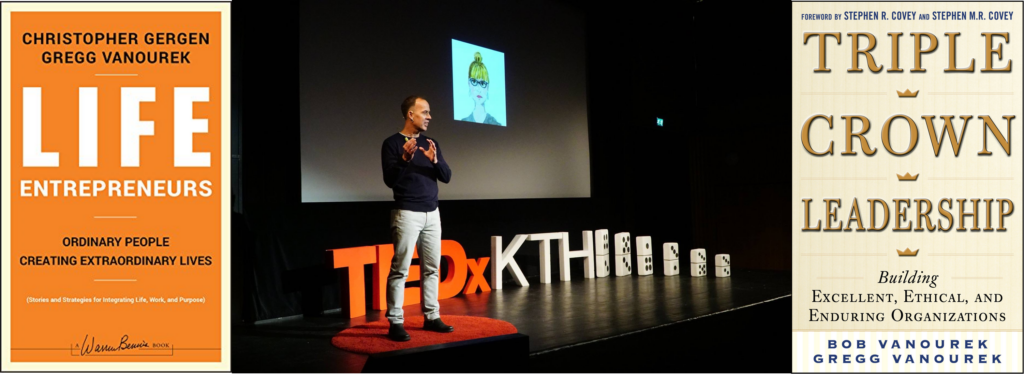
Gregg Vanourek is a writer, teacher, and TEDx speaker on personal development and leadership. He is co-author of three books, including LIFE Entrepreneurs: Ordinary People Creating Extraordinary Lives (a manifesto for living with purpose and passion) and Triple Crown Leadership: Building Excellent, Ethical, and Enduring Organizations (a winner of the International Book Awards). He has worked for market-leading ventures and given talks or workshops in 8 countries. Check out his Crafting Your Life & Work online course or get his monthly newsletter. If you found value in this article, please forward it to a friend. Every little bit helps!