
Create a life you love with Gregg's "Crafting Your Life and Work course"

The 7 Most Common Career Regrets (And What They Tell Us)

Got career regrets? Talk to almost any experienced professional and you’ll hear some version of a career regret. It can be staying too long in a bad situation. Or playing it too safe. Ignoring an inner nudge to change. Making choices for the wrong reasons. Getting lost in work. Roads not taken. Years spent pursuing someone else’s definition of success.

According to a survey of 1,000 workers in the U.S., U.K., France, and Germany:

  • 66% of workers have work-related regrets.
  • “Half of people regret being in their chosen career.” (O’Neill, 2025)

Here are the seven most common career regrets, according to the research:


Regret: Choosing a career based only on financial considerations and neglecting other important factors, like purpose, passion(s), flexibility, and autonomy. (Gulati, 2012; Pillemer, 2012)

Daniel Gulati interviewed 30 professionals ranging from age 28 to 58, asking each person about their biggest career regret so far. He writes, “By far the biggest regret of all came from those who opted into high-paying but ultimately dissatisfying careers.” (Gulati, 2012)

Dr. Karl Pillemer conducted a research project over decades that involved responses from more than 1,200 elders (age 65 and older, but most in their 70s and 80s), asking them about the important lessons they’re like to pass on to younger people. A key finding:

“…the elders believe that the biggest career mistake people make is selecting a profession based only on potential earnings. A sense of purpose and passion for one’s work beats a bigger paycheck any day.” (Pillemer, 2012)


Regret: Choosing a career based on what others think you should do (i.e., the influence of parents, teachers, classmates, society) instead of what you want to do. (Tieger et al., 2013)

The pressures are real. Especially when you’re young and still learning about yourself and not yet clear on all the options—or how to choose.

  • “One of the greatest regrets in life is being what others would want you to be, rather than being yourself.” -Shannon L. Alder, author
  • “…occupational regret is lived out on a daily basis as individuals labor in occupations they wish they had never entered.” -Wrzesniewski, A., Tosti, J., and Landman, J. (Yale, 2006)


Regret: Spending too much time in job that makes you unhappy, without looking for a new job. (Pillemer, 2012)

Many people are stuck in frustrating work situations. A bad boss. A toxic culture. Too much office politics. Academic researchers talk about “career inaction,” “stagnaters,” and “dysfunctional staying.” According to a survey of 1,000 workers in four countries, more people regret staying at a job too long (58%), as opposed to quitting a job (38%).

  • “I wish I’d not spent so many years in an average job. Life is over so quickly.” -Pearl, an Australian retiree, as told to Bronnie Ware in The Top Five Regrets of the Dying
  • Almost uniformly, those who had actually quit their jobs to pursue their passions wished they had done so earlier.” (Gulati, 2012)
  • “A big part of me looks back and thinks, ‘you know, you’ve been doing this since you were… twenty-five—you’re now nearly forty.’ And I’m thinking ‘that whole time you’ve had periods of regret, so maybe it’s not for you.’” -teacher, cited in Budjanovcanin, A., & Woodrow, C. (2022)

Take the Traps Test

We all fall into traps in life. Sometimes we’re not even aware of it, and we can’t get out of traps we don’t know we’re in. Evaluate yourself with our Traps Test.


Regret: Getting so caught up in your career that you neglect other important aspects of your life, like health, family, and friendships. (O’Neill, 2025; Ware, 2019)

According to a survey of 1,000 workers in four countries, 59% of workers regret not prioritizing work-life balance in their career. (O’Neill, 2025)

“I wish I hadn’t worked so hard…. What a stupid fool I was. I worked too damn hard and now I am a lonely, dying man. The worst part is that I have been lonely for the whole of my retirement and I need not have been…. There is nothing wrong with loving your work and wanting to apply yourself to it, but there is so much more to life.” -John, retired Australian businessman, as told to Bronnie Ware in The Top Five Regrets of the Dying


Regret: Not developing the confidence to change your career or start your own business. (Gulati, 2012; O’Neill, 2025; Pink, 2022)

Often, people feel a pull or have a hunch, but then they let their doubts seep in or they keep putting it off.* According to a survey of 1,000 workers in four countries, 44% of workers regret not making a career change. (O’Neill, 2025)

  • “One of the most robust findings, in the academic research and my own, is that over time we are much more likely to regret the chances we didn’t take than the chances we did…. What haunts us is the inaction itself…. One especially common boldness regret was not starting a business of one’s own.” (Pink, 2022)
  • “Regret for the things we did can be tempered by time; it is regret for the things we did not do that is inconsolable.” -Sydney J. Harris, journalist and author
  • (I regret) “not leaving my safe job to follow my instinct and stay true to my core values sooner.” -Pennsylvania man, age 56 (Pink, 2022)
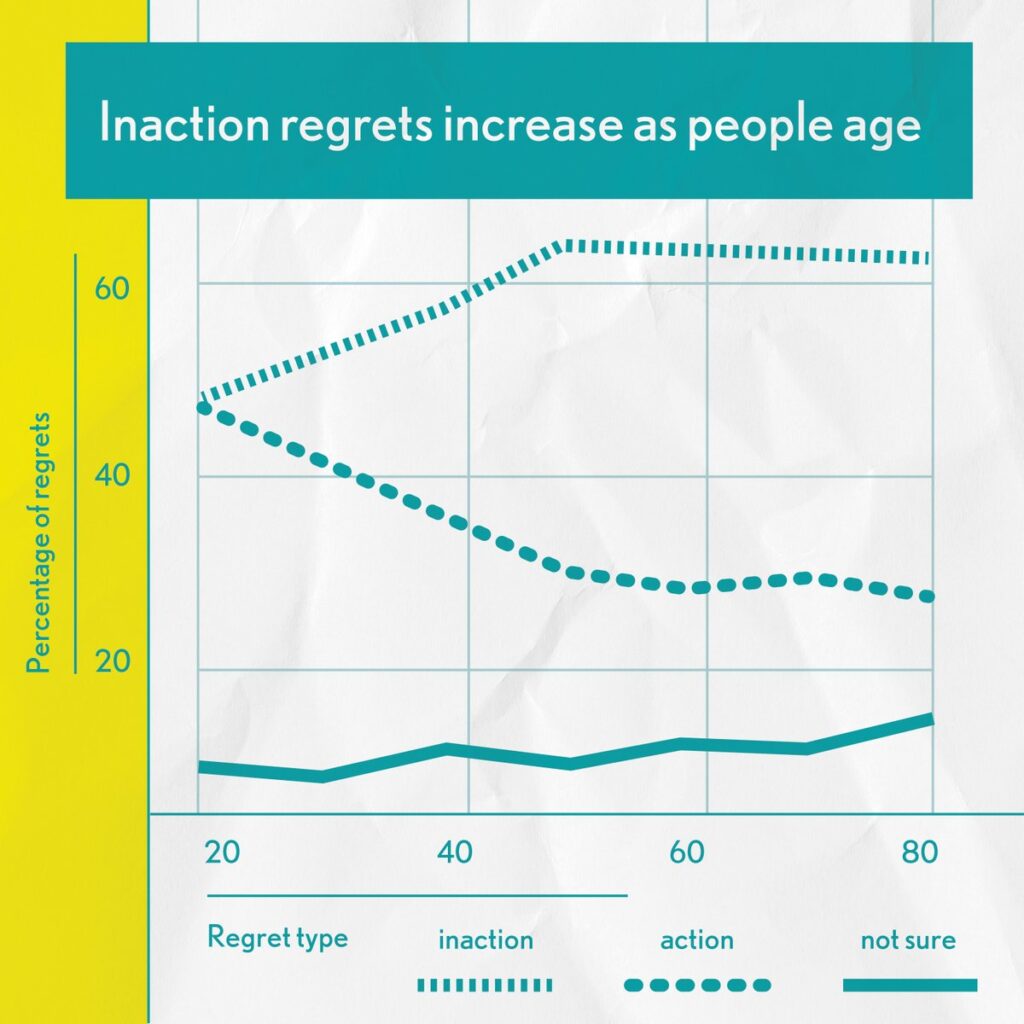
Source: Dan Pink, The Power of Regret (New York: Riverhead Books, 2022).


Regret: Thinking you have plenty of time, when in reality things go by astonishingly quickly. (Pillemer, 2012)

“Time is of the essence: Live as though life is short—because it is. The point is not to be depressed by this knowledge but to act on it, making sure to do important things now. The older the respondent, the more likely they were to say that life goes by astonishingly quickly. Said one elder: ‘I wish I’d learned that in my thirties instead of in my sixties!’” -Karl Pillemer, “Top 10 Lessons for Living from the Wisest Americans


Regret: Not taking advantage of opportunities that come along. (Gulati, 2012; Pillemer, 2012)

Maybe it was the lateral move to a different department you turned down because it felt risky. The speaking invitation you declined out of imposter syndrome. Or the chance to lead a high-visibility project you passed on because you didn’t feel ready yet.

“I regret not having the courage to be more bold earlier in my career and caring too much what other people thought of me.” -South-African woman, age 33 (Pink, 2022)
Quality of Life Assessment

Evaluate your quality of life in ten key areas by taking our assessment. Discover your strongest areas, and the areas that need work, then act accordingly.


More Career Regrets

The above regrets are the most common ones, according to the research. But there are other important regrets as well. For example:

  • Not asking for a raise or promotion. According to a survey of 1,000 workers in four countries, 60% of workers regret not asking for a pay increase, 51% regret not asking for a promotion, and 58% regret not negotiating their salary when they first took a job. (O’Neill, 2025)
  • Not building a professional network sooner.
  • Not investing in professional development and continuous learning.
  • Not speaking up or advocating for yourself (e.g., not sharing your accomplishments, needs, concerns, or ideas, which can lead to getting overlooked for promotions or opportunities).
  • Going it alone and not seeking mentorship or guidance.
  • Staying too long with one employer and forgoing chances to accelerate growth by moving to another organization(s).


The Challenges of Career Crafting

This research on the most common career regrets may sound straightforward, but let’s be honest: these matters of career crafting and change are far from easy in many cases.

You may be consumed by personal and professional obligations, making it hard to step out of the grind and work on change. The “switching costs” of career change can be high. Your identity can be wrapped up in your current work or profession.

Perhaps you’re risk-averse by nature. You can get trapped by “analysis paralysis.” Do you think it’s too late to make a change now? You may feel overloaded by options and not clear on what to do next. Or you may lack confidence to make desired changes.

All understandable. But keep in mind that work takes up such a big part of your life. Isn’t it worth crafting your life and work intentionally—and avoiding as many of these career regrets as you can?

This research on the most common career regrets can be catalytic, but only if you pay attention to it and heed its warnings. Is the regret about a mistake you’ve made, or really about something you haven’t lived into? Yet.

Sure, these career regrets can be ominous. But they can also become a blueprint for your next breakthrough.

Wishing you well with it. Let me know if I can help.
Gregg


Tools for You

Take the Traps Test

We all fall into traps in life. Sometimes we’re not even aware of it, and we can’t get out of traps we don’t know we’re in. Evaluate yourself with our Traps Test.


Related Resources


Postscript: Inspirations on Career Regrets

  • “Twenty years from now you will be more disappointed by the things you didn’t do than by the ones you did do. So throw off the bowlines. Sail away from the safe harbor. Catch the trade winds in your sails. Explore. Dream. Discover.” -Sarah Frances Brown (often misattributed to Mark Twain)
  • “Ten years from now, what will you regret never having tried?” -Alan Webber, Rules of Thumb
  • “…the secret of career satisfaction lies in doing what you enjoy most. A few lucky people discover this secret early in life, but most of us are caught in a kind of psychological wrestling match, torn between what we think we can do, what we (or others) feel we ought to do, and what we think we want to do. Our advice? Concentrate instead on who you are, and the rest will fall into place.” -Paul D. Tieger, Barbara Barron, and Kelly Tieger, Do What You Are


References

-Daniel Gulati, “The Top Five Career Regrets,” Harvard Business Review, December 14, 2012.

-Heather O’Neill, “Resume Now’s International Survey Finds 66% of Workers Suffer From Career Regrets,” ResumeNow.com, January 8, 2025. Another data point: When more than 29,000 people were asked this in a survey–“If you could do it all over again, would you choose the same career you’re in now?”–59 percent said no. Source: “Job Happiness Poll: Most Americans Wish They Could Hit Reset Button on Their Careers,” Parade, August 31, 2012, citing the Parade/Yahoo! Finance Job Happiness Survey.

-Karl Pillemer, 30 Lessons for Living: Tried and True Advice from the Wisest Americans (Avery, 2012). Dr. Pillemer is a gerontologist and professor at Cornell University who studies aging and conducts research on older adults’ life experiences and wisdom.

-Dan Pink, The Power of Regret: How Looking Backward Makes Us Move Forward (Riverhead Books, 2022). For this book, author Dan Pink surveyed 4,489 Americans across ages, races, genders, and socioeconomic levels. He also launched a companion website that collected open-ended regrets from more than 15,000 people in 105 countries. Pink found that nearly all regrets fall into four categories:

  1. foundation regrets: wishing you had made better decisions early on that would have set you up for success later, like saving money, staying in school, or taking care of your health.
  2. boldness regrets: wishing you had taken a chance or spoken up when you had the opportunity, instead of playing it safe out of fear.
  3. moral regrets: wishing you had done the right thing in a moment when you chose the easier, selfish, or dishonest path instead.
  4. connection regrets: wishing you had reached out to maintain or repair a relationship that drifted apart or ended, leaving things unsaid or unresolved.

-Paul D. Tieger, Barbara Barron, and Kelly Tieger, Do What You Are: Discover the Perfect Career for You through the Secrets of Personality Type (Little, Brown and Company, 2013).

-Bronnie Ware, The Top Five Regrets of the Dying (Hay House, 2019). Bronnie Ware is an Australian palliative care nurse who documented the common regrets expressed by patients in their final weeks of life, which she compiled into this book.

* To help avoid these kinds of regrets, Jeff Bezos, founder and CEO of Amazon, recommends the following: When facing a major decision, imagine yourself at age 80 looking back on your life and ask which choice would give you fewer regrets.

Crafting Your Life and Work Course

Regain clarity, direction, and motivation for your next chapter, starting with a powerful foundation of self-awareness and commitment to your values and aspirations.


+++++++++++++++++

Gregg Vanourek is a writer, teacher, and TEDx speaker on personal development and leadership. He is co-author of three books, including LIFE Entrepreneurs: Ordinary People Creating Extraordinary Lives (a manifesto for living with purpose and passion) and Triple Crown Leadership: Building Excellent, Ethical, and Enduring Organizations (a winner of the International Book Awards). He has worked for market-leading ventures and given talks or workshops in 8 countries. Check out his Crafting Your Life & Work online course or get his monthly newsletter. If you found value in this article, please forward it to a friend. Every little bit helps!


How to Do an Annual Life Review: 7 Questions

Article Summary: 

Most people don’t do an annual life review. Many don’t know where to begin. Here we guide you through 7 straightforward but powerful questions that will help you take stock and plan for the year ahead—a powerful self-leadership practice.

+++

Most people do annual performance reviews at work, but very few people do an annual life review. That’s odd. Why not check in on how things are going in your life?

With an annual life review, you can gain clarity about how things are really going in your life, seeing the big picture more clearly. You can spot patterns—even subtle, hidden ones—that reveal what’s helping you thrive and what’s holding you back.

Most importantly, doing a life review sets you up for action and momentum so you can start the new year with focus and intention.


7 Questions to Ask in Your Annual Life Review

One reason many people don’t do an annual life review is that they don’t know how. It doesn’t have to be complicated.

In fact, it can be as simple as asking yourself the following seven questions and writing down the answers.*


1. Highlights: What were the highlights of this past year?

Look back across your year and document the moments, relationships, and accomplishments that mattered most—the high points. By revisiting your calendar and/or photos, you’ll rediscover forgotten highlights.


2. Challenges: What were the top challenges from this past year?

Next, document the challenges you faced and where you fell short of what you had hoped for. Naming them can be cathartic. And reminding yourself of what you endured can be powerful evidence of your tenacity and resilience.


3. Habits: Which habits are helping me thrive, and which are holding me back?

Reflect on your habits and daily routines—both the ones that lift you up and the ones that hold you back. Doing so helps you decide what to keep, adjust, or let go of as you move forward.


4. Aspirations: What are my top aspirations for next year?

Next, note your hopes and dreams for the year ahead across all areas of life—from health and relationships to work, learning, and personal growth. Focus on what matters most to you and consider what would make the next year fulfilling and fun.

Take the Traps Test

We all fall into traps in life. Sometimes we’re not even aware of it, and we can’t get out of traps we don’t know we’re in. Evaluate yourself with our Traps Test.


5. Gratitude: What am I most grateful for from this year?

Now, focus on the people, moments, and experiences you’re most grateful for—including those that brought you the most joy. Take time to celebrate and savor the positives in your life.


6. Take-Aways: What are my top take-aways from this review process?

Finally, step back and look for patterns. Notice what drove your highs and lows, the lessons  learned, and the insights that can make next year even better.


7. Top Focus: What will be my top focus for the coming year?

Determine your top focus for the year ahead—the one area that, if prioritized, could make the biggest difference in your life. Focusing here gives you clarity, direction, and a guiding star for your actions. (It can also help you decide what you should stop doing or politely decline.)


That’s it. Seven powerful questions to take stock and set you up for success in the new year. See below for my Annual Life Review Template.


Annual Life Review Template


Annual Life Review

Reflect on the past year and clarify what matters most for the year ahead.

1. Highlights

What stood out as the best moments or wins from this past year?

2. Challenges

What were the most significant obstacles or difficulties I faced?

3. Habits

Which habits supported my growth, and which ones limited it?

4. Aspirations

What do I most want to create, pursue, or become in the year ahead?

5. Gratitude

What am I deeply grateful for from this past year and what brought me joy?

6. Key Takeaways

What insights or lessons emerged from this reflection?

7. Primary Focus

What single focus will matter most in the coming year?


Conclusion: How to Do an Annual Life Review

As you go through this process, give yourself grace. Don’t expect a perfect year. That’s a fool’s errand.

Instead, focus on honoring your real year—messiness and frustrations included. Approach the process with curiosity and self-compassion. And with thanks and wonder. Let insight replace self-criticism. Guard your heart and have faith.

Pro Tip: This process is helpful when done alone but much richer when you do it with others. Share your annual life review with someone you trust. Even better, exchange reviews and discuss them together. Doing so can deepen your connection. Together you can brainstorm creative new ideas, provide encouragement, and hold each other accountable for your chosen commitments.

In the end, doing an annual life can bring more clarity and insight to your life. A renewed sense of agency. And determination to keep learning and growing. It lays the groundwork for action and momentum, helping you enter the new year ready to thrive.

Wishing you well with it—and let me know if I can help.
Gregg


Tools for You

Quality of Life Assessment

Evaluate your quality of life in ten key areas by taking our assessment. Discover your strongest areas, and the areas that need work, then act accordingly.


Related Articles


Appendix: Additional Life Review Questions (Extra Credit)

For most people, answering the seven questions above will be enough. But if you want to go deeper, here are eight more targeted questions you can ask to turbocharge your annual life review:

1. Quality of Life: In what areas is my quality of life high, and which ones need work? (Resource: Quality of Life Assessment.)

2. Traps of Living: What are the top things that are inhibiting my happiness and fulfillment? (Resource: Traps Test.)

3. Purpose: To what extent am I living purposefully, and what more will I do? (Resource: “How to Discover Your Purpose.”)

4. Values: To what extent am I building my life around what’s important to me and upholding my deeply held beliefs, and what more will I do? (Resource: Personal Values Exercise.)

Personal Values Exercise

Complete this exercise to identify your personal values. It will help you develop self-awareness, including clarity about what’s most important to you in life and work, and serve as a safe harbor for you to return to when things are tough.


5. Vision: To what extent am I working toward my vision of the good life (a bold and vivid picture of my desired future), and what more will I do? (Resource: “How to Craft a Vision of the Good Life.”)

6. Strengths: To what extent am I using my core strengths (the things at which I most excel) in my life, and what more will I do? (Resource: Strengths Search.)

7. Passions: To what extent am I building my passions (the things that consume me with palpable emotion over time) into my life, and what more will I do? (Resource: Passion Probe.)

8. Goals: To what extent am I clear about the desired results I’d like to achieve and organizing my life and time accordingly? What more will I do on this front? (Resource: Goals Guide: Best Practices in Setting and Pursuing Goals.)


Postscript: Inspirations on How to Do an Annual Life Review

  • (Doing a personal annual review) “will be your highest leverage activity all year long.” -Matthias Frank, writer
  • “The unexamined life is not worth living.” -Socrates
  • “When you review your year as a whole, seemingly unrelated parts of your life come into focus at once, enabling you to connect the dots.” -Fadeka Adegbuyi, writer
  • “Without reflection, we go blindly on our way, creating more unintended consequences, and failing to achieve anything useful.” –Margaret J. Wheatley, writer and teacher
  • “There is one art of which people should be masters—the art of reflection.” -Samuel Taylor Coleridge, English poet, philosopher, and theologian
  • “Follow effective action with quiet reflection. From the quiet reflection will come even more effective action.” -Peter Drucker, consultant and author

Crafting Your Life and Work Course

Regain clarity, direction, and motivation for your next chapter, starting with a powerful foundation of self-awareness and commitment to your values and aspirations.


* It’s important to write down your answers for several reasons. For example, it gives you a record to review. You can compare years and assess progress. Also, it’s easier to track your progress and hold yourself accountable when you have a written starting point.

+++++++++++++++++

Gregg Vanourek is a writer, teacher, and TEDx speaker on personal development and leadership. He is co-author of three books, including LIFE Entrepreneurs: Ordinary People Creating Extraordinary Lives (a manifesto for living with purpose and passion) and Triple Crown Leadership: Building Excellent, Ethical, and Enduring Organizations (a winner of the International Book Awards). He has worked for market-leading ventures and given talks or workshops in 8 countries. Check out his Crafting Your Life & Work online course or get his monthly newsletter. If you found value in this article, please forward it to a friend. Every little bit helps!

How to Be More Present with People

Article Summary: 

These days, it’s getting harder and harder to be fully present with the people around us. Learn what presence is, why it matters, the barriers to it, and how to practice it.

+++

Do your days feel frenzied, frenetic, and frantic instead of peaceful and purposeful? With packed schedules, endless to-do lists, and all the demands of modern life, you may find it hard to be fully present with the people around you.

What people really want from you when they’re with you is your presence—your full and undivided attention. Signs of focus and care.

When they get it, it’s powerful, in part because the experience of receiving full attention from someone is so rare these days.


What Is Presence?

What does it mean to be present with someone? Presence means being deeply tuned in to the person you’re with. You’re aware of the moment you’re in and what’s going on with you emotionally. It entails:

  • being mentally, emotionally, and physically engaged (not distracted or preoccupied)
  • listening intently (and without thinking about how you’ll respond)

Being present requires mindful attention. For starters, that means putting down the phone. But it also means silencing your inner chatter about your task list or what’s bothering you. It’s all about focusing on the now.

“Presence is not some exotic state that we need to search for or manufacture. In the simplest terms, it is the felt sense of wakefulness, openness, and tenderness that arises when we are fully here and now with our experience.”
-Tara Brach


The Benefits of Presence

What are the benefits of presence? When you’re actually present with people, it:

  • shows respect and care
  • creates a climate of safety
  • helps them feel seen, valued, and understood
  • offers emotional relief to people who feel overwhelmed or unseen
  • helps move interactions from surface-level interaction to genuine connection
  • builds trust
  • improves communication
  • strengthens relationships
  • deepens intimacy*
  • makes gatherings more meaningful and memorable
“When you love someone, the best thing you can offer is your presence.
How can you love if you are not there?”

-Thich Nhat Hanh

Presence also has positive effects on its giver, not just the recipient. Being present can be an antidote to anxiety. It can enhance your joy and heighten your appreciation of people and things.

Take the Traps Test

We all fall into traps in life. Sometimes we’re not even aware of it, and we can’t get out of traps we don’t know we’re in. Evaluate yourself with our Traps Test.


What Prevents You from Being Fully Present?

Why is being fully present with people so freakin’ hard? There are many barriers to presence, including:

  • our daily deluge of digital distractions
  • emotional overwhelm
  • unprocessed stress
  • unresolved worries
  • incessant cognitive chatter
  • reflexive multitasking

Part of the problem is our overly rushed culture. Are you afraid of slowing down and falling behind or missing out on things? And does that keep you bouncing from one thing to another? Is your use of technology and devices sapping your ability to get and remain present and focused?

“In the 21st century, being fully in the present moment is becoming something of a Herculean feat, and we live in a state of near-constant distraction.”
-Charlie Huntington, “Presence: Meaning, Benefits, & Theory,” Berkeley Well-Being Institute


How to Be More Present with People: Stop Phoning It In

Here are eight ways you can be more present with people:

  1. Recall how awful it feels when people are distracted and not paying attention to you.
  2. Put your phone away. (Seriously, if it’s nearby, it will pull you into its virtual vortex.)
  3. Pause and breathe before starting a conversation.
  4. Maintain eye contact.
  5. Pay attention to details like the person’s tone and body language.
  6. Notice when your attention starts wandering and bring it back to the person in front of you.
  7. Acknowledge their key points and feelings.
  8. Ask follow-up questions (e.g., “say more about that…”).

Quality of Life Assessment

Evaluate your quality of life in ten key areas by taking our assessment. Discover your strongest areas, and the areas that need work, then act accordingly.


Conclusion: A Call to Presence

Presence is becoming harder and rarer in this age of attention hijacking. The algorithms are shrewd. Swiping, doom scrolling, and binge watching don’t lend themselves to deep presence with people.

Being fully present with the people you’re with helps you create more meaningful moments with them. And of course, it costs nothing but time and attention.

Why not show up fully for the people around you? Give them the gift of your time and undivided attention. You’ll both be glad you did.
Gregg


Tools for You


Related Articles & Resources


Postscript: Inspirations on How to Be More Present with People

  • “Life is available only in the present moment.” -Thich Nhat Hanh
  • “As soon as you honor the present moment, all unhappiness and struggle dissolve, and life begins to flow with joy and ease. When you act out the present-moment awareness, whatever you do becomes imbued with a sense of quality, care, and love—even the most simple action.” -Eckhart Tolle
  • “We convince by our presence.” -Walt Whitman

* Presence can also help facilitate intimacy and a higher quality sexual connection with your partner. Source: Silverstein, R. G., Brown, A. C. H., Roth, H. D., & Britton, W. B. (2011). Effects of mindfulness training on body awareness to sexual stimuli: implications for female sexual dysfunction. Psychosomatic Medicine, 73(9), 817–825.

Crafting Your Life and Work Course

Regain clarity, direction, and motivation for your next chapter, starting with a powerful foundation of self-awareness and commitment to your values and aspirations.


+++++++++++++++++

Gregg Vanourek is a writer, teacher, and TEDx speaker on personal development and leadership. He is co-author of three books, including LIFE Entrepreneurs: Ordinary People Creating Extraordinary Lives (a manifesto for living with purpose and passion) and Triple Crown Leadership: Building Excellent, Ethical, and Enduring Organizations (a winner of the International Book Awards). Check out his Crafting Your Life & Work online course or get his monthly newsletter. If you found value in this article, please forward it to a friend. Every little bit helps!

How to Use Anticipation to Boost Your Happiness

Article Summary: 

Even if your days are heavy with stress, pressure, and uncertainty, the magic of anticipation can lift your spirits as you look ahead toward something exciting.

+++

Legendary NFL quarterback Tom Brady won seven Super Bowl titles, five Super Bowl MVP awards, and three league MVP awards. Along the way, he set the records for career passing yards, touchdown passes, and quarterback wins. When somebody asked him which Super Bowl ring was his favorite, he replied:

“The next one.”

Brady was channeling the power of anticipation—looking forward to future experiences or events that bring you excitement and joy. In Sense and Sensibility, Jane Austen wrote about “that sanguine expectation of happiness which is happiness itself.”

You’ve probably basked in the sweet glow of anticipation, but you may not realize just how important it is to your health and wellbeing.


Sweet Anticipation

Many of my sweetest childhood memories are animated by anticipation:

Christmas morning
Birthday parties
Amusement parks
Friday night pizza after soccer practice
Sleepovers
Halloween
Beach outings
Bedtime stories

Now that I’m older, my anticipation targets have changed, but they still fill me with energy and excitement.

Take the Traps Test

We all fall into traps in life. Sometimes we’re not even aware of it, and we can’t get out of traps we don’t know we’re in. Evaluate yourself with our Traps Test.


How Anticipation Boosts Happiness

It turns out that there are many benefits of anticipation. For example, it can:

  • improve your mood, happiness, quality of life, and mental health
  • boost your job satisfaction (by shifting your focus from challenges and stressors to sought-after achievements and rewards)
  • prevent or reduce burnout
  • help you build your perseverance and resilience
“Anticipating fun times and enjoyable experiences is great for our mental health. It lifts our spirits and our mood. It also motivates us to persevere through challenges.” -Kelly Nardella, psychologist

How does this work? According to researchers, when you’re anticipating something, the reward centers in your brain activate, and these play an important role in your motivation and wellbeing.

The simple act of anticipating something enjoyable prompts your brain to release mood-enhancing chemicals like dopamine, serotonin, and endorphins. Anticipation can also amplify the enjoyment of the reward when it finally arrives.

According to researchers, the anticipation effect is so strong that looking forward to a positive event can boost your wellbeing even more than remembering one that already happened. One study found that positive anticipation can boost your mood even when you’re facing something stressful. For example, planning a fun night out after a pressure-filled workday can significantly alter your outlook for that day.

The effects even show up physiologically. In a 2018 study, participants were asked to anticipate a positive event while in a functional MRI machine. The brain scans revealed that this anticipation triggered the release of dopamine—a neurotransmitter tied to pleasure, satisfaction, and motivation.*

Looking forward to positive experiences can also strengthen your resilience, according to researchers. By thinking about future successes or joys, you can gain motivation and a sense of purpose. Anticipating positive events redirects your attention from today’s stress to tomorrow’s rewards.

Quality of Life Assessment

Evaluate your quality of life in ten key areas by taking our assessment. Discover your strongest areas, and the areas that need work, then act accordingly.


Ways to Bring More Anticipation into Your Life

So what can you do with this? Here are things you can do to leverage the power of anticipation in your life and work:

1. Take charge of your free time. If you don’t actively plan your free time, it can fizzle out in the busyness of daily life. Without deliberately setting up enjoyable and meaningful activities, you won’t have enough exciting experiences to look forward to, and you’ll miss out on the emotional boost that anticipation provides.

2. Plan fun activities. Set aside regular time for enjoyment and unwinding. Hobbies. Date nights. Excursions. Adventures. Time with family and friends. Having these experiences to look forward to can reduce work stress and facilitate an enjoyable and engaging life.

3. Make anticipation a daily habit. Each evening, reflect on or jot down at least one thing you’re looking forward to.

4. Align anticipation with your priorities. What are the things that light you up most? You’re more likely to value and cherish experiences and connections with others than possessions.

5. Invest in anticipation at home. If you’re in a relationship or have a family, make an effort to give your partner and/or family members fun things to look forward to.

6. Invest in anticipation at work. If you’re a manager or have a team that you work with, make an effort to give your colleagues fun things on their future docket.

7. Savor the experiences you’ve been anticipating. Savoring lets you deeply enjoy the experience once it arrives.

8. Be grateful for the experiences you’ve had. By being thankful for an experience you’ve been anticipating, you extend its emotional benefits and reinforce your positive feelings.


Conclusion: Boost Your Happiness through Anticipation

These days, you probably have enough things that you dread, whether it’s boring meetings or other frustrating situations. Why not flip the script?

Anticipation is a simple but powerful tool for boosting your happiness. By planning exciting and meaningful activities and experiences to look forward to, you can create more uplifting moments. Do this and watch how it transforms not only your free time but your work, energy, and sense of fulfillment.

Anticipation can be a great way to brighten your days and lift the spirits of those around you. Here’s to bringing more fun experiences and events into our lives—and enjoying the sweet pull they have on us.
Gregg


Tools for You

Take the Traps Test

We all fall into traps in life. Sometimes we’re not even aware of it, and we can’t get out of traps we don’t know we’re in. Evaluate yourself with our Traps Test.


Related Articles

* “Using event-related functional magnetic resonance imaging, 40 participants were scanned while they were performing an emotion anticipation task, in which they were instructed to anticipate the positive or neutral events. The results showed that bilateral medial prefrontal cortex (MPFC) were activated during anticipation for positive events relative to neutral events, and the enhanced brain activation in MPFC was associated with higher level of well-being.” -Luo Y, Chen X, Qi S, You X, Huang X. Well-being and Anticipation for Future Positive Events: Evidences from an fMRI Study. Front Psychol. 2018 Jan 9.


Postscript: Inspirations on How Anticipation Boosts Happiness

  • “The idea of waiting for something makes it more exciting.” -Andy Warhol
  • “Anticipation of pleasure is, in itself, a very considerable pleasure.” -David Hume
  • “The pleasure isn’t in doing the thing, the pleasure is in planning it.” -John Green, Paper Towns
  • “We need the sweet pain of anticipation to tell us we are really alive.” -Albert Camus
  • “‘Well,’ said Pooh, ‘what I like best,’ and then he had to stop and think. Because although Eating Honey was a very good thing to do, there was a moment just before you began to eat it which was better than when you were, but he didn’t know what it was called.” -A. A. Milne, Winnie-the-Pooh
  • “Never forget that anticipation is an important part of life. Work’s important, family’s important, but without excitement, you have nothing. You’re cheating yourself if you refuse to enjoy what’s coming.” -Nicholas Sparks, Three Weeks with My Brother
  • “If you come at four in the afternoon, I’ll begin to be happy by three.” -Antoine de Saint-Exupéry, The Little Prince
  • “Plotting a trip is nearly as enjoyable as actually taking one. Merely thinking about a pleasurable experience is itself pleasurable. Anticipation is its own reward.” -Eric Weiner

Crafting Your Life and Work Course

Regain clarity, direction, and motivation for your next chapter, starting with a powerful foundation of self-awareness and commitment to your values and aspirations.


+++++++++++++++++

Gregg Vanourek is a writer, teacher, and TEDx speaker on personal development and leadership. He is co-author of three books, including LIFE Entrepreneurs: Ordinary People Creating Extraordinary Lives (a manifesto for living with purpose and passion) and Triple Crown Leadership: Building Excellent, Ethical, and Enduring Organizations (a winner of the International Book Awards). Check out his Crafting Your Life & Work online course or get his monthly newsletter. If you found value in this article, please forward it to a friend. Every little bit helps!

Career Tips for Young Professionals

The job market today? It’s tough. If you’re a young professional just starting out, or even a few years in, you know the feeling: the landscape is brutal and the competition is fierce.

Consider the following: The unemployment rate for new job market entrants—including recent college graduates and others just beginning their full-time careers—reached a nine-year high this year, according to federal data. Their share of the total unemployed population also climbed to its highest level in decades.

Meanwhile, the once-reliable path from college to career may be breaking down. For the first time in modern history, the bachelor’s degree is failing to deliver on its core promise of access to white-collar jobs, according to researchers at The Burning Glass Institute, a labor-focused research and data lab. Federal data shows that 20- to 24-year-olds with bachelor’s degrees now face the highest relative unemployment levels of any education group.*

U.S. Federal Reserve Chair Jerome Powell has pointed out that we’re in a “low-firing, low-hiring environment,” which makes it tough for young workers (and others) to break into the labor force. The result for many young workers is frustration and self-doubt. One observer has called it “Gen Z’s career apocalypse.”

Landing a great job in this environment can feel like an uphill battle. It’s easy to feel overwhelmed or unsure about how to approach the beginning of your career.

But here’s the good news: there are great opportunities out there if you know how to approach things and differentiate yourself.


Career Tips for Young Professionals

Given this challenging context, here are 12 career tips for young professionals:

1. Know yourself deeply. That means knowing your personal values (what’s most important to you), your strengths (the things at which you most excel), your passions (the things that consume you with palpable emotion over time), and your purpose (why you’re here). This requires time for reflection. Knowing yourself well gives you a strong personal foundation—and safe harbor in the storms. That will help you stay true to your own guiding lights and not get caught up in chasing other people’s definitions of success.

“…the secret of career satisfaction lies in doing what you enjoy most. A few lucky people discover this secret early in life, but most of us are caught in a kind of psychological wrestling match, torn between what we think we can do, what we (or others) feel we ought to do, and what we think we want to do. Our advice? Concentrate instead on who you are, and the rest will fall into place.” -Paul D. Tieger, Barbara Barron, and Kelly Tieger, Do What You Are

2. Focus on learning and growth. When considering job options (if you’re fortunate enough to have them), prioritize opportunities for learning and growth. Find out whether the organization offers valuable learning and development opportunities.

Adopt a “growth mindset” (not a fixed mindset), and look for organizations with a “learn-it-all” culture (not a “know-it-all” culture). Your ability to learn quickly and adapt will serve you well. Be curious, ask questions, and seek feedback (and get good at receiving and acting on it). Develop a consistent habit of lifelong learning.

“…prioritize continuous learning and skill development…. Investing in your ongoing learning not only boosts your current job performance but also positions you for future career opportunities, showcasing your commitment to personal and professional growth and enhancing your adaptability in a dynamic job market.” -Cole Amstutz, Vice President of Commercial Business Development, ServiceMaster by Rice

3. In this age of technology and A.I., double down on human skills. As technology handles more and more routine tasks, your professional value is increasingly tied to uniquely human traits. Things like critical thinking, emotional intelligence (EQ), empathetic communication, and team collaboration. Machines can do a lot, but there’s no substitute for the human factor. Ultimately, strengthening your EQ and problem-solving abilities will help you navigate nuanced client or group interactions, lead teams, and drive innovation.

Crafting Your Life and Work Course

Regain clarity, direction, and motivation for your next chapter, starting with a powerful foundation of self-awareness and commitment to your values and aspirations.


4. Explore and test your career options. If you haven’t yet found that powerful combination of what you like to do, what you’re good at, and what you can get paid for, you’re wise to remain in what I call “discover mode” and try things. Get exposure to different functional areas. Consider important variables like the size (small, medium, large) and stage (early-, middle-, late-) of the venture that suits you. Be open to career pivots. Very few careers these days are straight lines. Meanwhile, each role you take can teach you something valuable if you have a growth mindset.

“One of the things is putting pressure on having that perfect solution lined up. While we should dream big, sometimes we need to make smaller moves and small experiments to build confidence and gather data and grow more organically in a new direction. In reality, what works is getting anchored in existing strengths and experiences and have a general feeling of success. There is no real way to know the answers… of what to pursue next in our careers unless we’re running small tests and learning from them.” -Jenny Blake, author and podcaster

5. Find a wave and ride it. Venture capitalist Erik Straser wisely urges young workers to find a powerful market trend that will continue for decades and take advantage of it. (Examples: AI, automation, clean tech, smart infrastructure, aging populations, mental health, urbanization, upskilling and reskilling, multigenerational workforces, circular economy, etc.) What are current trends that pique your interest and that you’re well positioned to help advance (or could be)? Remember: you have a choice about which industry and sector you work in.

6. Focus on building “career capital.” In his excellent book, So Good They Can’t Ignore You, Georgetown University computer science professor Cal Newport emphasizes the importance of “career capital” (vocational assets that you can leverage). You build career capital by developing and using rare and valuable skills, not by chasing prestige or convenience, and adding value to your colleagues and organization via smart and hard work. Once you have enough of it, you can trade it for desirable things like autonomy, a flexible schedule, and meaningful work. It gives you freedom and leverage to shape your career and choose work that fits you well and that matters to you.

“(Career capital) is the key currency for the work you love.”
-Cal Newport

Have a high standard of performance and do excellent work consistently. And don’t wait for permission. Take initiative by volunteering for projects, suggesting improvements, and “leading from below.”

Take the Traps Test

We all fall into traps in life. Sometimes we’re not even aware of it, and we can’t get out of traps we don’t know we’re in. Evaluate yourself with our Traps Test.


7. Look for a great boss. It can make all the difference in your work experience and in the opportunities you get (or don’t get) to contribute and advance. A strong manager provides guidance, challenges you to grow, and opens doors you might never reach on your own. Good leaders help you build skills and set a foundation for long-term success. Often, choosing who you work for is just as important as what you do.

8. Vet the organizations you’re focusing on. Interviews should be a two-way street. Yes, you need to demonstrate your value and give them compelling reasons to hire you. But you should also ask thoughtful, specific questions about their culture, training, and career paths during your interviews. Doing so shows you’ve done your homework and signals that you have high standards for where you invest your time and energy. (See my article, “How to Find a Great Organization to Work For.”)

9. Engage in “discovery-driven networking.” In their book, The Innovator’s DNA, Jeff Dyer, Hal Gregersen, and Clayton Christensen distinguish between two types of networking. “Delivery-driven networking” (the standard type) focuses on accessing resources, selling products, and advancing caeers. It’s transactional and focused on getting what you want. “Discovery-driven networking,” by contrast, focuses on learning new things, obtaining new perspectives, and testing ideas in process. It’s more relational and reciprocal—and effective and enjoyable.

“The currency of real networking is not greed but generosity.”
-Keith Ferrazzi, Never Eat Alone

Your networking should be focused on building real connections, not trying to extract things from people. Seek out people who inspire you and listen deeply to their guidance. Also, make sure that your relationships are reciprocal. Be generous and help others, even when you’re young. If you take time to develop and maintain a strong network, it will be one of the greatest assets in your career.

Quality of Life Assessment

Evaluate your quality of life in ten key areas by taking our assessment. Discover your strongest areas, and the areas that need work, then act accordingly.


10. In a crowded job market, find ways to be a “purple cow.” Seth Godin’s “purple cow” is a metaphor for remarkable things that stand out so much they get noticed (like a purple cow in a field of ordinary cows). In a crowded market, being ordinary can make you invisible. Think of a hiring manager with way too much to do and a stack of fifty resumes and a full day of interviews. How can you be the person who stands out from the pack and makes the interview memorable, engaging, and fun?

11. Play the long game. When you’re young, it’s easy to get caught up in immediate concerns like starting pay or benefits. Yes, those are important—but still only pieces of the bigger picture. Focus on opportunities that help you grow, build valuable skills, and work on things that truly matter to you. (It helps to develop a vision of the good life, including clarity about what a good career looks like for you.) And make sure you’re not caught up in your own ego. Never stop asking yourself how you’ll serve and make a difference.

“Be patient, but don’t get complacent. Exercise some patience while putting in the work today that will get you closer to achieving your long-term goals. In a society that wants everything on demand, be willing to sacrifice some short-term gains in order to reach greater success in the long run.” -Nick Blyth, Senior Vice President, Holmes Murphy

12. Don’t neglect the fun factor! Enjoying what you do isn’t just a perk. It fuels your energy, creativity, and resilience. When your work engages and excites you, you’re more likely to grow, perform at your best, and stick with it long enough to build valuable skills and encounter exciting opportunities. A career you love makes your hard work worthwhile and also brings out the best of you in other settings.


Conclusion: Craft a Career You Love

There’s no doubt the job market today is challenging and competitive. It may feel hopeless sometimes. But you have agency.

You’re at the start of a career journey that will likely span several decades. You’ll be spending a huge portion of your life at work. Your career isn’t something that happens to you or something you should settle for or stumble into. It’s something you can choose and craft if you play it smart.

So, take responsibility, be intentional about your choices, and recognize that every move you make today can start setting you up for a better tomorrow. The market may be tough, but with clarity about who you are and what you want—and conviction about building a career you love—you can rise to the challenge.

Wishing you well with it, and let me know if I can help.
Gregg

Tools for You

Crafting Your Life and Work Course

Regain clarity, direction, and motivation for your next chapter, starting with a powerful foundation of self-awareness and commitment to your values and aspirations.


Related Articles & Resources


Postscript: Inspirations on Career Tips for Young Professionals

  • “One of the best pieces of advice for young people is, Get to yourself quickly. If you know what you want to do, start doing it.” -David Brooks, The Second Mountain
  • “The deepest vocational question is not ‘What ought I to do with my life?’ It is the more elemental and demanding ‘Who am I? What is my nature?’” -Parker Palmer, Let Your Life Speak
  • “Big career decisions don’t come with a map, but all you need is a compass. In an unpredictable world, you can’t make a master plan. You can only gauge whether you’re on a meaningful path. The right next move is the one that brings you a step closer to living your core values.” -Adam Grant, professor
  • “Your work is to discover your work and then with all your heart to give yourself to it.” -Siddhartha Gautama (the Buddha)
  • “Don’t obsess over finding your true calling. Instead, master rare and valuable skills. Once you build up the career capital that these skills generate, invest it wisely. Use it to acquire control over what you do and how you do it, and to identify and act on a life-changing mission.” -Cal Newport
  • “If the ladder is not leaning against the right wall, every step we take just gets us to the wrong place faster.” -Stephen R. Covey, educator and author
  • “Go to work for an organization or people you admire. It will turn you on. You ought to be happy where you are working. I always worry about people who say, ‘I’m going to do this for 10 years’ and ‘I’m going to do 10 more years of this.’ That’s a little like saving sex for your old age. Not a very good idea. Get right into what you enjoy.” -Warren Buffett, investor
  • “Your work is going to fill a large part of your life, and the only way to be truly satisfied is to do what you believe is great work. And the only way to do great work is to love what you do.”Steve Jobs, co-founder, Apple
  • “Align where you spend your time with what you care about the most. You’ll connect with like-minded leaders and feel the fulfillment of living out your purpose each day.” -Shannon Draayer, Director of Health and Well-being, WesleyLife
  • “Shadow Career is the term used to describe people who go on an alternative path from their true dream because they’ve given up on themselves.” -Dr. Benjamin Hardy, Be Your Future Self Now
  • “We spend far too much time at work for it not to have deep meaning.” -Satya Nadella, CEO, Microsoft
  • “Don’t aim at success—the more you aim at it and make it a target, the more you are going to miss it. For success, like happiness, cannot be pursued; it must ensue… as the unintended side-effect of one’s personal dedication to a cause greater than oneself.” -Victor Frankl, psychologist, author, and Holocaust survivor
  • “…God is calling you to serve Him in and from the ordinary, material, and secular activities of human life. He waits for us every day, in the laboratory, in the operating theatre, in the army barracks, in the university chair, in the factory, in the workshop, in the fields, in the home and in all the immense panorama of work. Understand this well: there is something holy, something divine, hidden in the most ordinary situations, and it is up to each one of you to discover it.” -Josemaria Escriva, Conversations
  • “Your career is like a garden. It can hold an assortment of life’s energy that yields a bounty for you. You do not need to grow just one thing in your garden. You do not need to do just one thing in your career.” -Jennifer Ritchie Payette, author
  • “Don’t be afraid or guilty to switch directions. You are not a failure for changing your mind on what you choose to do with your life. As someone who ended up finding a different career path, I initially struggled with this, but over time, I have taken comfort in realizing the ability to adapt and change is a skill.” -Dannie Patrick, Community Foundation of Greater Des Moines
  • “Networking isn’t just about collecting business cards; it’s about genuinely connecting with people, understanding their needs and finding ways to add value to their lives or businesses. Invest time in cultivating meaningful connections, both within and outside your industry. These relationships can open doors, provide valuable insights and even lead to unexpected opportunities down the road.” -Erin Knupp, Director of Business Development, Beal Derkenne Construction

* The Burning Glass Institute partly attributes the problem to the growing number of young Americans earning four-year degrees, outpacing demand for such workers—a gap unlikely to close soon. Also, the rise of artificial intelligence threatens entry-level knowledge jobs. A recent Stanford study found that U.S. workers ages 22 to 25 in AI-exposed roles have seen a 13% drop in employment since 2022.

Crafting Your Life and Work Course

Regain clarity, direction, and motivation for your next chapter, starting with a powerful foundation of self-awareness and commitment to your values and aspirations.


+++++++++++++++++

Gregg Vanourek is a writer, teacher, and TEDx speaker on personal development and leadership. He is co-author of three books, including LIFE Entrepreneurs: Ordinary People Creating Extraordinary Lives (a manifesto for living with purpose and passion) and Triple Crown Leadership: Building Excellent, Ethical, and Enduring Organizations (a winner of the International Book Awards). Check out his Crafting Your Life & Work online course or get his monthly newsletter. If you found value in this article, please forward it to a friend. Every little bit helps!

How to Improve Your Financial Health

Article Summary: 

Many people struggle financially not only due to economic conditions and the job market but also because managing money can feel complex and overwhelming. They’re unsure of where to begin or what to do. Or they have money hang-ups and counterproductive mindsets that hold them back from achieving financial health. Here we give you the essentials of financial health, including steps you can take to build security, reduce stress, build wealth, and improve your quality of life.

+++

Financial health is about more than numbers and money. It’s a cornerstone of your overall quality of life. When your finances are in order, you have less stress. You gain the freedom to focus on what matters most—like your health, happiness, and relationships.

By understanding and managing your income, spending, debt, savings, and investments, you set the stage for both financial security and a life of your choosing.


10 Ways Your Financial Health Can Enrich Your Quality of Life

Having your finances in order can help:

  1. reduce your stress and anxiety
  2. give you more freedom and flexibility
  3. support your health
  4. boost your confidence
  5. take pressure off your relationships
  6. enable fun and meaningful activities and experiences
  7. build resilience against setbacks
  8. give you peace and comfort
  9. allow for generosity
  10. fund your dreams

“The highest form of wealth is the ability to wake up every morning and say, ‘I can do whatever I want today.’” -Morgan Housel, The Psychology of Money

So, how to improve your financial health? We walk through it below.

Take the Traps Test

We all fall into traps in life. Sometimes we’re not even aware of it, and we can’t get out of traps we don’t know we’re in. Evaluate yourself with our Traps Test.


1. Financial Foundations: Managing Income and Expenses

Your financial foundations are about your income, spending, and budget. Think of them as the blocking and tackling of financial health.


Income

Here are top tips for approaching your income with an eye toward boosting your financial health:

  • Monetize your strengths. Identify what you do best and what you love doing and then find ways to turn your strengths and passions into income.
  • Increase your value. Continuously develop skills and expertise that make you more valuable in the marketplace.
  • Seek growth opportunities. Pursue new projects or roles that enhance your experience and earning potential.
  • Negotiate your worth. Ask for fair compensation that reflects your contributions and market value. And fight for it, if need be. Be prepared to walk.
  • Diversify your income streams. Build multiple sources of income—such as side ventures, consulting, or investments—to reduce risk and give you more flexibility. Ideally, this includes passive income.
“The key to becoming wealthy is the ability to convert earned income into passive income or portfolio income as quickly as possible…. The rich do not work for money. They know how to have money work hard for them. Ordinary earned income is money you work for, and passive and portfolio income is money working for you.”
-Robert Kiyosaki, Rich Dad Poor Dad


Spending

The average U.S. adult spends roughly $18,000 each year on non-essential items and services, according to a 2019 estimate. In a 2022 survey, 36% of Americans said their garage was so cluttered with stuff that they could no longer park their car inside.

Here are top tips for how to approach your spending:

  • Live below your means. Keep your expenses comfortably lower than your income to make room for saving and investing.
  • Spend intentionally. Align your spending with your values and priorities, not mindless habits or social pressure.
  • Distinguish needs from wants. Cover essentials first, then make mindful choices about discretionary spending. According to Jonathan Clements, “You’ll end up treasuring almost nothing you buy.”
  • Delay gratification. Pause before a major purchase and ask whether your future self would approve of that expenditure.
  • Track your spending. Awareness is power. Knowing where your money goes helps you make better decisions and stay in control.
“Spending money to show people how much money you have is the fastest way to have less money.”
-Morgan Housel, The Psychology of Money


Budgeting

Here are top tips on budgeting:

  • Know your inflows and outflows. Track all your income and expenses to understand where your money is going. Use technology to help streamline this.
  • Set clear categories and limits. Allocate funds for essentials, savings, investments, and discretionary spending.
  • Plan for irregular expenses. Include annual or occasional costs (like taxes, insurance, or gifts) so they don’t derail your budget.
  • Adjust regularly. Review and tweak your budget regularly to reflect changes in income, priorities, or goals.
  • Use your budget as a tool. Treat it as a guide to make intentional choices and achieve your financial goals.

Quality of Life Assessment

Evaluate your quality of life in ten key areas by taking our assessment. Discover your strongest areas, and the areas that need work, then act accordingly.


2. Building Reserves and Financial Security

Building reserves and working on financial security is about providing stability and peace of mind through savings, insurance, management of debt, and smart planning.


Savings

Here are top tips for handling savings:

  • Pay yourself first. Treat saving as your first bill to pay each month, before covering other expenses. This ensures you consistently build financial security instead of relying on whatever money you may or may not have left over.
  • Set clear goals. Define short-, medium-, and long-term savings goals. Fun examples:
    • dream vacation fund
    • dream wardrobe refresh
    • “yes” fund (having money ready to say yes to spontaneous invites, last-minute trips, or new opportunities)
  • Automate savings. Use automatic transfers to make saving consistent and effortless.
  • Keep an emergency fund (of at least three to six months of living expenses). Prioritize liquidity for unexpected expenses to avoid going into debt.
  • Review and adjust. Regularly check progress and increase savings as your income grows or your goals change.
“Do not save what is left after spending: instead spend what is left after saving.”
-Warren Buffett


Financial Security

Here are key actions you can take to enhance your financial security:

  • Protect yourself with insurance. Health, disability, and life insurance (and perhaps umbrella insurance) safeguard against financial shocks.
  • Plan for retirement. Contribute to retirement accounts early and consistently. And check your progress regularly. (Many brokerage accounts give you a retirement readiness score.)
  • Plan for contingencies. Stuff happens. Think unexpected job loss (so common these days), major medical expenses, or urgent home or car repairs. Include backup income sources, legal safeguards, and estate planning.


Debt

By early 2025, 90% of Americans had debt and U.S. consumer debt had climbed to $18.2 trillion, with mortgage debt accounting for 70% of that, auto loans at 9%, student loans at 9%, and credit card debt at 7%.

Here are top tips for how to approach debt:

  • Avoid debt as much as possible. If you do need it, borrow strategically. Only take on debt that helps build assets or increases future earning potential, like a home mortgage. Don’t borrow for depreciating items (like cars, furniture, appliances, or jewelry) or lifestyle consumption. Borrow only what you can comfortably repay.
  • Prioritize paying off high-interest debt. Pay off credit cards and other high-interest loans first. They can make your debt grow rapidly and may cause it to spiral out of control quickly.
  • Keep debt manageable. Ensure monthly payments are affordable relative to your income.
  • Make and follow an aggressive repayment plan for debt you do have. Set clear goals and timelines for paying down your debt.
“…the single most dangerous obstacle to building wealth: debt…. Debt is a crisis that needs immediate attention. If you are currently in debt, paying it off is your top priority. Nothing else is more important.”
-JL Collins, The Simple Path to Wealth

Take the Traps Test

We all fall into traps in life. Sometimes we’re not even aware of it, and we can’t get out of traps we don’t know we’re in. Evaluate yourself with our Traps Test.


3. Growth and Wealth-Building

Growth and wealth-building are about assets (things you own that can appreciate and build net worth, like your home or a rental property), investments (putting your money into things that can grow over time, like stocks, property, or other opportunities), and an intentional wealth-building strategy.


Assets and Investments

Here are top tips for how to approach assets and investing:

  • Start early and stay consistent. Starting to invest early is wildly powerful because of the remarkable phenomenon of compounding: your money not only earns returns, but those returns also earn returns over time. The longer your money stays invested, the more it can grow. Even small contributions made early can become much larger over decades. By contrast, starting later means you have to invest much more to reach the same goal. In short: time is your most important ally in growing wealth. Time in the market is magic, while trying to “time the market” is a fool’s errand. (Because markets are hard to predict and frequent trading incurs costs, consistent long-term investing almost always outperforms trying to time the market.)
  • Focus on long-term growth. Prioritize assets that appreciate over time rather than chasing short-term gains.
  • Diversify your portfolio.* Spread investments across asset classes, sectors, and geographies to reduce risk. Ways to diversify:
    • Spread your investments. Don’t put all your money into one asset, sector, or market.
    • Mix asset types. Combine stocks, bonds, real estate, and other investments to balance growth and stability.
    • Maintain geographic diversity. Investing globally can protect against localized economic or political shocks.
    • Balance risk and reward. Include both conservative and growth-oriented assets to align with your goals and tolerance. Play both offense and defense.
  • Understand what you own. Invest only in products, companies, or funds you understand and believe in.
  • Review and rebalance regularly. Periodically adjust your portfolio to maintain alignment with your goals and risk tolerance.
“…the biggest lie in personal finance is that you can be rich if you just cut your spending….
Actually, the only ‘secret’ that I know to get rich is to grow your income and invest in income-producing assets.”
-Nick Maggiulli, “The Biggest Lie in Personal Finance
“Thirty years from now, you’ll wish you’d invested more in stocks.”
-Jonathan Clements

Quality of Life Assessment

Evaluate your quality of life in ten key areas by taking our assessment. Discover your strongest areas, and the areas that need work, then act accordingly.


4. Financial Planning and Strategy

Done properly, financial planning and strategy involves creating an overarching roadmap that addresses income, spending, savings, risk, and wealth-building.


Financial Planning

Here are top tips for approaching financial planning:

  • Set clear financial goals. Define what you want to achieve in the short-, medium-, and long-term to guide your decisions.
  • Plan for the future. Include retirement, education, and major life events or goals in your financial roadmap.
  • Review and adjust regularly. Revisit your plan periodically to reflect changes in income, goals, or life circumstances.
Ask yourself: Am I on track to meet my financial goals and retirement needs?


Wealth-Building Strategy

A wealth-building strategy is a roadmap for growing your money, securing your financial future, and reaching your goals. Here are examples of things that could be part of your wealth-building strategy:

  • Increase income strategically.
  • Save and invest in diverse assets consistently.
  • Aggressively pay down debt and then avoid it.
  • Leverage appreciating assets, like real estate or investments, to grow net worth.
  • Take advantage of tax-advantaged accounts (e.g., retirement accounts).
  • Minimize investment fees and expenses (via low-cost funds and accounts).


Take Charge of Your Finances

Taking charge of your finances is essential. It gives you control, reduces stress, and creates freedom to pursue your goals. When you actively manage your money, you can make informed decisions rather than reacting to circumstances and facing nasty surprises.

For example, you can take charge by creating a budget, automating savings, aggressively paying down high-interest debt (or better yet, avoiding it in the first place), and investing consistently for the future. By taking deliberate steps, you can turn money from a source of anxiety into a tool that supports your wellbeing and dreams.


Put Your Finances in Perspective

Keep your finances in perspective. Money should support your life rather than dominate it. It’s a tool, not a measure of your worth or happiness. Letting financial concerns overwhelm you can take a toll on your relationships and wellbeing.

Be sure to prioritize experiences, relationships, and self-care. True wealth is a life that’s connected, meaningful, and joyful, not dollars in the bank.


Common Financial Traps

Many people unknowingly fall into common financial traps that can derail their financial health. Examples:

  • Avoiding your finances, because it’s complex or uncomfortable.
  • Blaming your financial challenges on external circumstances instead of taking full responsibility for them.
  • Comparing your finances to others and resenting people for what they have.
  • Postponing working on finances because you’re too busy.
  • Thinking it’s too complicated for you. (It’s not.)
  • Thinking it’s too late to become financially strong and then giving up on it.


Conclusion

Improving your financial health doesn’t have to be overwhelming or all-consuming. By intentionally managing your income, spending, debt, savings, and investments, you can build security, wealth, and freedom.

Small, consistent actions—like budgeting, automating savings, and diversifying investments—compound over time, giving you the security and space to live fully. When you align your financial habits with your values, you turn money into a tool that helps you craft a good life. Authentic alignment in personal finance allows you to channel your resources toward what matters most to you.

Is it easy? No. With high prices, a tough job market, and so much volatility, improving your finances can feel overwhelming. Give yourself grace. Get started with one or two steps. Then start habit stacking and see the momentum you build. And keep going!

Finally, don’t forget to be grateful for what you have—and not obsessed with or resentful of what you don’t have—and thankful to and mindful of all those who have helped you along the way, from parents and teachers to friends, coaches, and mentors. True wealth comes in many forms.

Wishing you all the best.
Gregg


Tools for You

Take the Traps Test

We all fall into traps in life. Sometimes we’re not even aware of it, and we can’t get out of traps we don’t know we’re in. Evaluate yourself with our Traps Test.


Related Articles


Recommended Books & Magazines on Financial Health

  • John C. Bogle, The Little Book of Common Sense Investing
  • JL Collins, The Simple Path to Wealth
  • Rachel Cruze, Know Yourself, Know Your Money
  • Joe Dominguez and Vicki Robin, Your Money or Your Life
  • Napoleon Hill, Think and Grow Rich
  • Morgan Housel, The Psychology of Money
  • Robert Kiyosaki, Rich Dad, Poor Dad
  • Mel Lindauer et al., The Bogleheads’ Guide to Investing
  • Paul Merriman and Richard Buck, We’re Talking Millions
  • Dave Ramsey, The Total Money Makeover
  • Grant Sabatier, Financial Freedom
  • Sahil Bloom, The 5 Types of Wealth
  • Eric Tyson, Investing for Dummies
  • Kiplinger (personal finance magazine)


Related Podcasts on Financial Health


*Appendix: Diversification Types for Your Investments

Here are examples of ways you can diversify your investments:

  • Across Asset Classes: stocks, bonds, real estate, and cash or cash equivalents (e.g., savings or money market funds).
  • Within Asset Classes:
    • Stocks: large-, mid-, and small-cap stocks across different sectors.
    • Bonds: a mix of government, municipal, and corporate bonds with varying maturities and risk levels.
  • Geographic Diversification: domestic stocks and investments from international and emerging markets.
  • Investment Vehicles: a mix of index funds, ETFs, and mutual funds instead of only buying individual stocks (these funds automatically spread risk).
  • Sector Diversification: avoid concentrating too heavily in one industry or theme; balance exposure among sectors like technology, healthcare, finance, consumer goods, and energy.
  • Alternative Investments: consider small allocations (if appropriate for your situation) to real estate investment trusts (REITs), commodities, or private assets.
  • Liquidity Balance: keep an adequate portion of assets in liquid investments (like cash or short-term bonds) for flexibility and emergencies, with the rest in longer-term growth assets.


Postscript: Inspirations on How to Improve Your Financial Health

  • “Wealth consists not in having great possessions, but in having few wants.” -Epictetus, Greek Stoic philosopher
  • “You must remember to love people and use things, rather than to love things and use people.” -Archbishop Fulton J. Sheen
  • “Don’t let your happiness depend on something you may lose.” -C.S. Lewis
  • “Greed is a bottomless pit which exhausts the person in an endless effort to satisfy the need without ever reaching satisfaction.” -Erich Fromm
  • “It is not life and wealth and power that enslave men, but the cleaving to life and wealth and power.” -Siddhartha Gautama (the Buddha)
  • “Here’s the most fundamental finding of happiness economics: the factors that most determine our happiness are social, not material.” -Jonathan Rauch, The Happiness Curve
  • “If you aren’t willing to own a stock for ten years, don’t even think about owning it for ten minutes.” -Warren Buffett
  • “…the greatest reason for lack of financial success was because most people played it too safe. People are so afraid of losing that they lose.” -Robert Kiyosaki, Rich Dad Poor Dad
  • “You should like risk because it pays off over time. But you should be paranoid of ruinous risk.” -Morgan Housel, The Psychology of Money
  • “There are many things money can buy, but the most valuable of all is freedom. Freedom to do what you want and to work for whom you respect. Those who live paycheck to paycheck are slaves. Those who carry debt are slaves with even stouter shackles.” -JL Collins, The Simple Path to Wealth

Note: I can give you tips and encouragement, but I can’t make your investments magically grow. Investing is risky. I’m not a financial advisor, and this is general guidance, not investment advice. Handle your money wisely and maybe chat with a pro before hitting “buy.”

Crafting Your Life and Work Course

Regain clarity, direction, and motivation for your next chapter, starting with a powerful foundation of self-awareness and commitment to your values and aspirations.


+++++++++++++++++

Gregg Vanourek is a writer, teacher, and TEDx speaker on personal development and leadership. He is co-author of three books, including LIFE Entrepreneurs: Ordinary People Creating Extraordinary Lives (a manifesto for living with purpose and passion) and Triple Crown Leadership: Building Excellent, Ethical, and Enduring Organizations (a winner of the International Book Awards). Check out his Crafting Your Life & Work online course or get his monthly newsletter. If you found value in this article, please forward it to a friend. Every little bit helps!

A Guide to Life-Boosting Activities

Article Summary: 

Busy professionals and leaders often neglect activities that enrich their lives. How to bring more fun, play, travel, and hobbies into your life.

+++

You want to live fully and vibrantly—but between work and family responsibilities, your good intentions slip away.

Many modern workers don’t have enough margin in their lives. For some, their identity is too wrapped up in their work. Others are addicted to work: they can’t stop doing it, or even thinking about it.

Too often, the lighter and fun parts of life get squeezed out. Big mistake.


How Your Activities Can Enrich Your Quality of Life

Activities that bring fun, rest, and renewal are powerful catalysts for joy, fulfillment, and resilience. They aren’t indulgences. They’re fuel for living well. Here are four powerful benefits of regularly making time for fun and life-boosting activities:

1. Personal and Emotional Renewal. Activities that delight or relax you help reduce stress, improve mood, and restore energy. They boost your resilience. When your inner battery is charged, you’re better able to show up for others and to adapt well when challenges arise.

 2. Improved Creativity and Problem-Solving. Stepping away from work for play or hobbies gives your brain breathing room. That mental space often sparks fresh ideas and unexpected solutions.

 3. Stronger Relationships. Shared fun—whether games with family, travel with friends, or hobby groups—deepens bonds and creates memories you’ll treasure.

 4. A Richer Life Story. Fun activities and adventures add color and texture to your life. They summon both memories and meaning.


Ways to Boost Your Quality of Life via Activities

Below are some common life-boosting activities you can engage in to add more richness to your days. You don’t have to do them all. Just pick a few that speak to you and weave them into your routines.


Play

As adults, it’s common for play to disappear from our lives. Common, but harmful. Is it time to bring any of the following back into your life?

  • board and card games
  • game nights
  • musical instruments
  • play time with friends, kids, or grandkids
  • puzzles
  • sports (recreational or competitive)
  • team games or lighthearted competitions at work or with friends
  • trivia nights
  • video games
“Our brains are built to benefit from play no matter what our age.”
-Theresa A. Kestly, psychologist


Fun

Too busy with work and family obligations? Is your fun factor ridiculously low? Look below and see if there are things that call out to you:

  • arcades
  • comedy shows
  • concerts
  • cooking or baking experiments or classes
  • escape rooms
  • festivals
  • ice cream runs
  • karaoke nights
  • outdoor adventures (e.g., hiking, paddleboarding)
  • spontaneous outings
  • theme park trips
  • trying new experiences just for the fun of it

Quality of Life Assessment

Evaluate your quality of life in ten key areas by taking our assessment. Discover your strongest areas, and the areas that need work, then act accordingly.


Hobbies

With all that you’re doing, have you let any hobbies fall by the wayside? Take a look below and see if any of them strike your fancy:

  • art
  • baking or cooking
  • birdwatching
  • book clubs
  • clubs or online communities for shared interests
  • crafting or D.I.Y. projects
  • gardening
  • painting
  • photography
  • playing musical instruments
  • pottery
  • woodworking


Travel

With busy schedules and daily responsibilities, opportunities for travel often get postponed or overlooked. Are you overdue for any of the following?

  • adventure travel
  • cruise vacations
  • cultural or heritage tours
  • eco-tourism
  • food and wine tours
  • group tours or guided trips
  • international adventures
  • local getaways and gems (e.g., parks, trails, historic sites)
  • road trips
  • service trips or cultural exchanges to broaden horizons
  • solo travel
  • weekend getaways
  • wellness retreats


Free Time

When life is full of obligations, your free time can easily slip away unnoticed. Ask the following:

  • Are you in the habit of taking relaxing breaks throughout the day?
  • Do you have slow mornings with coffee, meditation, journaling, or prayer?
  • Are there unstructured blocks of time in your calendar for wandering, reading, or just chilling out?
  • Do you take walks without earbuds to notice your surroundings?


Vacations

Many people these days don’t take advantage of the vacation time they have. (See the Appendix below for data on this.)

  • Are you taking longer breaks every year to rest, reset, and reconnect with loved ones?
  • When on vacation, do you stay off work email and truly unplug?

Take the Traps Test

We all fall into traps in life. Sometimes we’re not even aware of it, and we can’t get out of traps we don’t know we’re in. Evaluate yourself with our Traps Test.


Note: You Must Take Charge of Your Free Time

If you don’t take charge of your free time, it can easily slip away in the busyness of daily life. You may be highly organized and intentional at work, yet passive about your free time: doomscrolling on your phone, binge-watching Netflix, or simply zoning out. Intentionally designing and protecting your free time is essential if you want it to be restorative and enriching.

“Unless a person takes charge of them, both work and free time are likely to be disappointing.”
-Mihaly Csikszentmihalyi


Reflecting on Your Activities

You’re wise to pause and reflect on your activities every once in a while. Ask yourself:

  • What’s your interest level in the activity?
  • Is it fun?
  • How much do you enjoy it?
  • Do you find it engaging?
  • Does it relax and restore you?
  • Does it lead to memorable or meaningful activities?

Activities that score high on these factors will not only enrich your life but also energize you for your other responsibilities.


Connecting with Others Is Key

We’re living through what many experts call a loneliness epidemic. The pandemic only intensified the challenge of staying social. While there’s absolutely a time and place for solo activities, don’t overlook how much more enjoyable and rewarding many activities become when you share them with others. When you build in opportunities to connect, you boost your sense of belonging and strengthen relationships.

“Playing a game together actually builds up bonds and trust and cooperation.
We actually build stronger social relationships as a result.”

-Jane McGonigal, game designer


Conclusion

Our world is rich with possibilities. You’ve got countless ways to play, rest, and explore. Every day offers a new chance to take you on energizing adventures or recharge your spirit.

Choose life-boosting activities that speak to you. Don’t let them fall by the wayside. The more you nurture yourself with animating and revitalizing activities, the more fully you can experience your days.
Gregg

“Doing what you love is the cornerstone of having abundance in your life.”
-Wayne Dyer


Tools for You

Quality of Life Assessment

Evaluate your quality of life in ten key areas by taking our assessment. Discover your strongest areas, and the areas that need work, then act accordingly.


Related Articles and Books


Postscript: Inspirations on Life-Boosting Activities and Quality of Life

  • “The drive to play freely is a basic, biological drive. Lack of free play may not kill the physical body, as would lack of air, food, or water, but it kills the spirit and stunts mental growth.” -Peter Gray, psychologist
  • “Play is the foundation of learning, creativity, self-expression, and constructive problem-solving.” -Susan Linn, psychiatrist
  • “Play is our brain’s favorite way of learning.” -Diane Ackerman, author
  • “Almost all creativity involves purposeful play.” -Abraham Maslow, American psychologist
  • “People rarely succeed unless they have fun in what they are doing.” -Dale Carnegie
  • “If you’re not having fun, you’re doing something wrong.” -Groucho Marx
  • “Laughter is an instant vacation.” -Milton Berle
  • “Fun is one of the most important—and underrated—ingredients in any successful venture.” -Richard Branson, British entrepreneur
  • “Hobbies are great distractions from the worries and troubles that plague daily living.” -Bill Malone
  • “A hobby a day keeps the doldrums away.” -Phyllis McGinley
  • “See the world. It’s more fantastic than any dream.” -Ray Bradbury, writer
  • “To travel is to live.” -Hans Christian Andersen, Danish author
  • “Once a year, go someplace you’ve never been before.” -Tenzin Gyatso, 14th Dalai Lama
  • “Traveling—it leaves you speechless, then turns you into a storyteller.” -Ibn Battuta
  • “There is a kind of magicness about going far away and then coming back all changed.” -Kate Douglas Wiggin
  • “Plotting a trip is nearly as enjoyable as actually taking one. Merely thinking about a pleasurable experience is itself pleasurable. Anticipation is its own reward.” -Eric Weiner


Appendix: Vacations and Holidays across Countries

In the U.S., workplaces give much less time off for vacations and holidays than many of their peer countries around the world. See below.

What’s more, many American workers don’t take the time off they’re given. According to a recent Pew Research Center survey, about 46% of U.S. workers with employer-provided paid time off—covering vacation, medical appointments, or minor illnesses—use less time than they are entitled to. Here are the top reasons cited:

  • Don’t feel they need to take more time off (52%)
  • Worry they might fall behind at work (49%)
  • Feel badly about co-workers taking on additional work (43%)
  • Think taking more time off might hurt chances for advancement (19%)
  • Think they might risk losing their job (16%)
  • Manager discourages taking time off (12%)

Some additional research:

  • “Ironically, what’s supposed to be a source of relaxation and restoration morphs into a stressor: As vacations approach, feelings of doubt and guilt creep in….
  • Upon moving to the U.S. in 2016, I was surprised at how pervasive vacation guilt appeared to be….
  • We found that 1 in 5 respondents to our survey experienced vacation guilt, and these concerns made them think twice about following through with their vacation plans. For those who eventually did take a vacation, they often tried to ease their guilt by going for fewer days. They might also apologize for taking a vacation or avoid talking about their vacation plans at work….
  • Some of the people we interviewed had pushed through their hesitation and taken their vacation as planned. Yet all of these employees believed that they’d been penalized for taking time off and that it led to poor performance reviews, despite the fact that their paid vacation days had been a clearly articulated, earned benefit….
  • The U.S. is the only advanced economy that doesn’t legally mandate a minimum number of vacation days. On top of that, only a handful of states require workers to be compensated for their unused vacation days…. many employees face a ‘use-it-or-lose-it’ situation, meaning unused vacation days don’t roll over from one year to the next….
  • the guilt that so many workers do feel may be symbolic of broader issues: an unhealthy workplace culture, a toxic boss or a weak social safety net.”

(Source: Karen Tan, “Researchers examine why so many American workers feel guilty taking vacation time,” PBS, July 27, 2025.)

Crafting Your Life and Work Course

Regain clarity, direction, and motivation for your next chapter, starting with a powerful foundation of self-awareness and commitment to your values and aspirations.


+++++++++++++++++

Gregg Vanourek is a writer, teacher, and TEDx speaker on personal development and leadership. He is co-author of three books, including LIFE Entrepreneurs: Ordinary People Creating Extraordinary Lives (a manifesto for living with purpose and passion) and Triple Crown Leadership: Building Excellent, Ethical, and Enduring Organizations (a winner of the International Book Awards). Check out his Crafting Your Life & Work online course or get his monthly newsletter. If you found value in this article, please forward it to a friend. Every little bit helps!

Are You Serving Enough Every Day?

Article Summary: 

Many people feel overwhelmed by the busyness of life and suspect they could be serving others much more. This blog offers a quick way to evaluate how much you’re serving in your daily life, along with practical ways to serve more.

+++

Every day, you see challenges all around you—not just in the headlines but among your own family, friends, and colleagues. Relationship and health challenges. Stress, loneliness, and loss. Beyond that, you see larger challenges like poverty, crime, and school shootings. It’s easy to feel overwhelmed or too busy to help.

But you’re wise to pause and ask:

Are you weaving service into your daily life—in your relationships, at work, in your community?

When you do, you can make a difference while enriching your own sense of purpose and wellbeing.


Serving People at Home

There are many ways to serve the people closest to you: your family, friends, neighbors, and classmates. It can be through small acts of kindness and caring. Or by guiding, teaching, coaching, or mentoring others.

You can serve by offering emotional support—being a good listener, an encourager, or a rock for someone in pain. Or welcoming new neighbors, hosting them for a meal, and including them in local activities. Ask yourself:

  • In what ways am I showing up for the people around me?
  • Do I consistently show kindness to those around me—my family, friends, and neighbors?
  • Am I taking opportunities to mentor, guide, teach, or support others when I can?
  • Do people see me as a good listener and a source of encouragement?

1: Needs Work
2: Doing Fine
3: Thriving

Quality of Life Assessment

Evaluate your quality of life in ten key areas by taking our assessment. Discover your strongest areas, and the areas that need work, then act accordingly.


Serving People at Work

Service shouldn’t stop at home. At work, you can serve your colleagues, customers, partners, and/or vendors in many ways. Sometimes it’s through acts of kindness—a friendly check-in or a word of thanks. Other times it’s by coaching or mentoring, whether formally through a program or informally over coffee. By actively sharing knowledge, offering help, and removing roadblocks, you can support your team members’ success and contribute to a healthier organizational culture.

Service at work also involves emotional support: listening well, cheering people on, or helping those who are stressed or struggling. It can be welcoming new colleagues, making sure they feel included in meetings and social events. And it can involve using your creative talents to uplift others—or offering pro bono professional services to people or causes that need them. Ask yourself:

  • To what extent am I showing kindness in my interactions at work?
  • Do I look for ways to guide, mentor, coach, or support others?
  • Am I actively supporting my teammates’ success, not just my own?
  • Do I provide encouragement and emotional support to colleagues who need it?
  • How do I welcome and include new people on the team?
  • What am I doing to contribute to a positive workplace culture?

1: Needs Work
2: Doing Fine
3: Thriving


Serving People You Come Across in Your Everyday Life

Opportunities to serve also arise every day in small, ordinary interactions with strangers. Think of the people you meet on the street, at the coffee shop, in stores, or at restaurants. Contributing here can be through simple gestures: holding a door open, smiling, thanking, being patient when things take longer than expected, or showing support to someone who’s having a bad day. Ask yourself:

  • How do I treat the people I meet in passing—cashiers, baristas, delivery drivers, and others?
  • Am I consistent in showing politeness, patience, and gratitude even when I’m rushed or stressed?
  • Do I look for small ways to make someone’s day better, like a smile or a kind word?

1: Needs Work
2: Doing Fine
3: Thriving

Take the Traps Test

We all fall into traps in life. Sometimes we’re not even aware of it, and we can’t get out of traps we don’t know we’re in. Evaluate yourself with our Traps Test.


Contributing to Places

Another way to serve is by contributing to the places and institutions that shape your life—schools, neighborhoods, faith communities, or your nation. You might donate resources or volunteer for a project. Or follow local and national issues and vote.

You can attend school board meetings, town halls, or online forums where decisions are made. Ask yourself:

  • How well am I supporting the institutions and communities that matter to me?
  • Do I regularly give time, talent, or resources to places that align with my values?
  • Am I engaged in civic life—voting, attending meetings, or participating in discussions that shape my community?

1: Needs Work
2: Doing Fine
3: Thriving


Contributing to Causes or Issues

You can also make a difference by contributing to larger issues or causes that matter to you—such as healthcare, poverty, mental health, or the environment. You might donate to organizations addressing these challenges. Or volunteer at their events.

You can also use your voice and influence. This might include speaking up for people or causes that need support, raising awareness among your friends, or calling for change through letters or petitions. Ask yourself:

  • Am I giving my time, resources, or talents to organizations working on the issues that matter most to me?
  • How well am I using my voice to speak up for people or causes that need support?
  • Am I helping to raise awareness or call for change in ways that are respectful, constructive, and effective?

1: Needs Work
2: Doing Fine
3: Thriving

Personal Values Exercise

Complete this exercise to identify your personal values. It will help you develop self-awareness, including clarity about what’s most important to you in life and work, and serve as a safe harbor for you to return to when things are tough.


Pro Tip: Build Your Service around These Three Things

One of the most fulfilling ways to serve is to align your contributions with what you’re naturally good at, what excites you, and what you care about. When you build your service around your strengths, passions, and values, it feels less like an obligation and more like an expression of who you are. You bring more energy, skill, and authenticity to what you’re doing—and the people you serve feel that.

Start by reflecting on your apex abilities. Are you a great listener, an organizer, a creative thinker, a connector? Someone who brings calm in a crisis? Think about the activities or causes that light you up. And then consider your core values: what matters most to you, the beliefs and principles you aspire to stand for. Ask yourself:

  • Which of my strengths can I use to serve others more effectively?
  • What causes or activities energize me?
  • How do my values inform who I want to serve or the way I want to contribute?
  • Where do my strengths, passions, and values overlap with real needs in my community or the world?

1: Needs Work
2: Doing Fine
3: Thriving


“Pervasive Service”

At its best, service isn’t something you do occasionally. It’s a defining feature of your life. In our book, LIFE Entrepreneurs, we called this “pervasive service.” When you embrace service as a guiding principle, it shapes your relationships, work, and daily actions. It becomes a lens through which you view opportunities, a habit that directs your choices, and a rhythm that carries you through life. Service, in this sense, isn’t a box to check or a compartmentalized activity. It’s woven into the fabric of your life.

Pervasive service means approaching each day with intentionality and being ready to grasp opportunities to make a difference. By making service a central tenet of your life, you can live more purposefully and joyfully—and watch as these daily actions add up to something extraordinary over time.

1: Needs Work
2: Doing Fine
3: Thriving


Conclusion: Commit to Serving More

Serving others isn’t just a lofty ideal. It’s something you can do every day, and it’s a gateway to a richer, more meaningful life.

Look at the different ways you’re already serving and consider where you might do more. Seek opportunities in your daily life, at work, in your community, and even in small everyday interactions. Remember, service doesn’t have to be grand to matter. Small, consistent acts of service ripple outward.

Anchor your service in your strengths, passions, and values. When your service aligns with who you are and what you care about most, it becomes more sustainable, impactful, and joyful.

The world needs people who not only care but act on their convictions. People who live and lead with heart. Here’s to serving more.
Gregg

Tools for You

Quality of Life Assessment

Evaluate your quality of life in ten key areas by taking our assessment. Discover your strongest areas, and the areas that need work, then act accordingly.


Related Articles & Books


Postscript: Inspirations on Service

  • “I don’t think there’s anything as wonderful in life as being able to help someone else.” -Betty Ford
  • “The best way to find yourself is to lose yourself in the service of others.” -Mahatma Gandhi
  • “When you feel sad, serve.” -unknown
  • “…if you’re hurting, you need to help somebody ease their hurt. If you’re in pain, help somebody else’s pain. And when you’re in a mess, you get yourself out of the mess helping somebody out of theirs. And in the process, you get to become a member of what I call the greatest fellowship of all, the sorority of compassion and the fraternity of service.” -Oprah Winfrey
  • “There are occasions and opportunities for service that will vary throughout anyone’s life. The initial gate is that you understand that that’s a piece of being a full person. It’s a matter of saying yes to the opportunity when it appropriately appears. Every day is a preparation for serving something.” -Buie Seawell, attorney and professor
  • “Life’s most urgent question is, ‘What are you doing for others?’” -Martin Luther King, Jr.
  • “It is high time the ideal of success should be replaced with the ideal of service.” -Albert Einstein
  • “Service is the very purpose of life. It is the rent we pay for living on the planet.” -Marian Wright Edelman, activist
  • “…the only ones among you who will be really happy are those who have sought and found how to serve.” -Albert Schweitzer
  • “…when you choose the paradigm of service, looking at life through that paradigm, it turns everything you do from a job into a gift.” -Oprah Winfrey
“Not everybody can be famous. But everybody can be great, because greatness is determined by service. You don’t have to have a college degree to serve. You don’t have to make your subject and verb agree to serve. You don’t have to know about Plato or Aristotle to serve. You don’t have to know Einstein’s theory of relativity to serve. You don’t have to know the second theory of thermodynamics in physics to serve. You only need a heart full of grace and a soul generated by love.” -Martin Luther King, Jr.

Crafting Your Life and Work Course

Regain clarity, direction, and motivation for your next chapter, starting with a powerful foundation of self-awareness and commitment to your values and aspirations.


+++++++++++++++++

Gregg Vanourek is a writer, teacher, and TEDx speaker on personal development and leadership. He is co-author of three books, including LIFE Entrepreneurs: Ordinary People Creating Extraordinary Lives (a manifesto for living with purpose and passion) and Triple Crown Leadership: Building Excellent, Ethical, and Enduring Organizations (a winner of the International Book Awards). Check out his Crafting Your Life & Work online course or get his monthly newsletter. If you found value in this article, please forward it to a friend. Every little bit helps!

Rating Your Job: A Work Satisfaction Checkup

Article Summary: 

Many people spend a huge portion of their lives at work, yet often struggle with bad bosses, unsupportive workplaces, or jobs that leave them drained. This work satisfaction checkup helps you rate your job so you can identify needed changes. If you’re wondering ‘How do I rate my job?’ this checklist can help.

+++

You probably spend much of your life at work. The quality of your work life can deeply affect your mental health, growth, happiness, energy, sense of meaning, and overall life satisfaction.

“Hundreds of studies have shown that job satisfaction and life satisfaction are positively related, and causal:
liking your job causes you to be happier all around.”

-Arthur C. Brooks and Oprah Winfrey, Build the Life You Want:
The Art and Science of Getting Happier

Unfortunately, many people work for bad bosses or labor in lame workplaces. According to Gallup, employee engagement hit a 10-year low in 2024.

“The way we’re working isn’t working.”
-Tony Schwartz, The Way We’re Working Isn’t Working
“Every worker needs to escape the wrong job.”
-Peter Drucker
“Oh, you hate your job? Why didn’t you say so? There’s a support group for that.
It’s called EVERYBODY and they meet at the bar.”
-George Carlin, comedian

Here’s a quick checkup to help you see how things are going with your work—and where some extra attention could make a big difference.


Work Satisfaction Checkup: Rating Your Job

Review the factors below and rate them using the scale provided.


Work Environment

Do you feel safe and supported in your workspace, both physically and psychologically? Are the work site, tools, and resources conducive to your best work? Are you free from hazards, exploitation, bullying, and abuse?

1: Needs Work
2: Doing Fine
3: Thriving


Workload

Do you have a reasonable and manageable workload that allows you to do your work without constant or excessive stress or burnout—and without harming your health and personal life? Are expectations realistic and deadlines achievable? Do you have clear visibility into your obligations and schedule so you can plan effectively?

1: Needs Work
2: Doing Fine
3: Thriving


Compensation*

Are you paid fairly for what you do, taking into account your skill level, responsibilities, peers, industry benchmarks, cost of living in your area, and the value of your contributions? Is the pay structure transparent and predictable, with clear opportunities for increases over time? Does your total compensation—including bonuses, incentives, or other rewards—accurately reflect your impact and results?

1: Needs Work
2: Doing Fine
3: Thriving


Benefits

Are the workplace benefits (health insurance, retirement plans, time off, etc.) sufficient and helpful to your well‐being? Do they support your life beyond work (family, health, rest, etc.)? Are they appropriate for your industry, sector, and geographic area?

1: Needs Work
2: Doing Fine
3: Thriving

Quality of Life Assessment

Evaluate your quality of life in ten key areas by taking our assessment. Discover your strongest areas, and the areas that need work, then act accordingly.


Manager

Does your manager treat you fairly and with respect? Do they set clear expectations and communicate effectively? Are they reasonable in their demands and supportive of your growth and wellbeing? Do you feel comfortable bringing up concerns and confident that they’ll listen and respond appropriately?

1: Needs Work
2: Doing Fine
3: Thriving

“Surveys show that one in two people at some point in their careers
have left their job to get away from their managers.”
-Jim Kouzes and Barry Posner, The Leadership Challenge


Flexibility

Do you have flexibility in how, when, or where you work (e.g., scheduling, remote/hybrid options)? Does the job allow you to balance work and personal life? Are you able to adjust your workload or schedule when unexpected demands arise?

1: Needs Work
2: Doing Fine
3: Thriving


Fairness

Are you treated fairly when it comes to expectations, opportunities, and rewards? Are expectations clear? Is decision-making transparent and just? Does the organization avoid discrimination and bias in all forms? Do policies, promotions, and recognition apply consistently across teams and roles?

1: Needs Work
2: Doing Fine
3: Thriving


Engagement

Do you feel invested in your work? Are you energized by your role rather than feeling drained or disengaged? Do you feel connected to your team, your manager, and the organization’s purpose and vision? Are your skills and strengths being put to use effectively?

1: Needs Work
2: Doing Fine
3: Thriving


Autonomy

Do you have enough freedom to decide how you approach your work and set priorities? Are you trusted to make your own decisions on many aspects of your job without excessive oversight? Are you adequately involved in shaping your tasks, methods, or schedule in ways that help you do your best work?

1: Needs Work
2: Doing Fine
3: Thriving


Opportunity for Advancement

Is there a clear path for you to take on greater responsibility or move up the organizational ladder? Do you see possibilities for role expansion or promotion? Are advancement opportunities based on merit and performance, and communicated transparently? Do you feel supported by your manager and organization in preparing for the next step in your career?

1: Needs Work
2: Doing Fine
3: Thriving


Learning and Growth

Are there chances to develop new skills, gain knowledge, get high-quality feedback regularly, and try things and learn from mistakes? Does your organization provide sufficient training opportunities, and does your work stretch you (in a good way)? Does your work contribute to your personal growth? And does your manager encourage and support your development?

1: Needs Work
2: Doing Fine
3: Thriving

Take the Traps Test

We all fall into traps in life. Sometimes we’re not even aware of it, and we can’t get out of traps we don’t know we’re in. Evaluate yourself with our Traps Test.


Opportunity for Achievement

Are you able to work toward excellence and mastery? Do you have goals to strive for? Do you receive feedback that helps you recognize your progress and identify ways to improve?

1: Needs Work
2: Doing Fine
3: Thriving

“The secret of joy in work is contained in one word—excellence.
To know how to do something well is to enjoy it.”

-Pearl S. Buck


Contribution

Does your work allow you to serve and contribute in ways that matter—to your team, organization, clients, and/or society? Do you feel your efforts make a tangible difference? Are you given opportunities to share ideas, take initiative, and have an impact beyond your core responsibilities?

1: Needs Work
2: Doing Fine
3: Thriving


Use of Strengths

Are you able to use your strengths (the things at which you most excel) in your work regularly? Do your tasks align with what energizes you and allows you to shine? Are you encouraged to leverage your unique skills to solve problems, lead initiatives, or contribute in other ways?

1: Needs Work
2: Doing Fine
3: Thriving


Progress on Meaningful Work

Do you have opportunities to get involved in projects that feel meaningful to you—aligned with your core values, worthy challenges, or something you care about? Are you able to make progress on them (not stuck in “busywork”)? Does your organization’s work serve a larger purpose?

1: Needs Work
2: Doing Fine
3: Thriving

“Of all the things that can boost emotions, motivation, and perceptions during a workday, the single most important is making progress in meaningful work. And the more frequently people experience that sense of progress, the more likely they are to be creatively productive in the long run. Whether they are trying to solve a major scientific mystery or simply produce a high-quality product or service, everyday progress—even a small win—can make all the difference in how they feel and perform.”
-Teresa M. Amabile and Steven J. Kramer, “The Power of Small Wins,” Harvard Business Review, May 2011


Belonging

Do you feel part of the team? At work, do you feel that your manager and colleagues care about you? Do you feel accepted, included, and respected by your colleagues and managers? And do you have a network of supportive and reliable colleagues?

1: Needs Work
2: Doing Fine
3: Thriving


Recognition

When you and your colleagues do good work, is it noticed? Do you receive appreciation and recognition that acknowledges your contributions? Is recognition timely, specific, and meaningful? Do you feel valued not just for outcomes, but also for effort, initiative, creativity, and collaboration?

1: Needs Work
2: Doing Fine
3: Thriving


Trust

Is there a high level of mutual trust between you and your peers, your boss, and others throughout your organization? Do you feel you can rely on others—and that they can rely on you? Are people honest, transparent, and consistent in their words and actions? Do you feel safe speaking up, sharing ideas, or admitting mistakes without fear of negative consequences?

1: Needs Work
2: Doing Fine
3: Thriving

“…trust is the most significant predictor of individuals’ satisfaction within their organizations.”
-James Kouzes and Barry Posner


Values Fit

Are you asked to compromise on your values or beliefs? Does your work—and your organization’s purpose, values, vision, culture, and priorities—align with what matters to you? Do you feel proud of the work you do and the impact it has? Does your organization’s behavior match its stated values?

1: Needs Work
2: Doing Fine
3: Thriving

“I had chosen to use my work as a reflection of my values.”
-Sidney Poitier, actor, director, and activist


Enjoyment

Do you enjoy going to work and doing what you do? Are there enough moments of fun, humor, satisfaction, and flow? Do you feel energized by your work day rather than drained? Are there aspects of your role that make you look forward to contributing and collaborating with others?

1: Needs Work
2: Doing Fine
3: Thriving

“Go to work for an organization or people you admire. It will turn you on. You ought to be happy where you are working. I always worry about people who say, ‘I’m going to do this for 10 years’ and ‘I’m going to do 10 more years of this.’ That’s a little like saving sex for your old age. Not a very good idea. Get right into what you enjoy.”
-Warren Buffett


What to Do with this Work Satisfaction Checkup

Here are tips on ways you can get the most out of this process for rating your job.

Celebrate: Identify and celebrate the areas you rated yourself as “thriving.” Also, think about what conditions make them possible so you can build more of them.

Assess the Big Picture. Look at your evaluation as a whole. Determine whether your workplace is good enough overall that it’s worth staying and trying to improve things, or if it has too many systemic problems that would be difficult or slow to fix. This can help you decide whether to invest in making changes where you are or to look for opportunities elsewhere. (See my article, “How to Find a Great Organization to Work For.”)

Identify Growth Areas: Pick one or two areas where you feel you need the most work, given the lower rating and the relative importance to you. (But don’t choose more than one or two to address initially. There’s great power in focus.)

Brainstorm Small Action Steps: For each of those areas, what’s one concrete thing you could do about it? Examples:

  • Ask your manager for input, feedback, and/or career development support.
  • Propose a new project that aligns with your strengths, passions, and values.
  • Ask your manager for more flexibility or a schedule adjustment while noting specifically how you’ll be able to support your team, meet your responsibilities, and achieve your performance goals.

Hold Yourself Accountable: Revisit this work satisfaction checkup in a few months to see what’s improved. Share your plans with a trusted colleague, mentor, or friend and ask them to check in with you about it in a set period of time (e.g., three months).

Quality of Life Assessment

Evaluate your quality of life in ten key areas by taking our assessment. Discover your strongest areas, and the areas that need work, then act accordingly.


Caution: Avoid the Danger of Passivity and Cynicism

It’s easy to fall into the habit of complaining about what’s wrong at work, ruminating on your frustrations, or assuming you can’t change things. But passivity and cynicism can quietly erode your motivation and capacity. Remember: you have agency.

Yes, the current job market is challenging, making it hard for many people to leave difficult jobs. Not everyone has the privilege of plentiful options or the freedom to walk away. And yet, even in challenging circumstances, it’s important not to slip into inertia or resignation.

You often have more control and influence over your work life than you realize—whether through proactive conversations, small improvements, or reframing how you approach your role. Or your mindset. Consider “job crafting”: intentionally shaping your tasks, relationships, and perceptions at work to better align with your strengths, passions, and values. Taking proactive steps gives you a sense of control and can dramatically enhance your work life.


Conclusion

Doing well at work isn’t just about salary, success, prestige, or “climbing the ladder.” It’s also about feeling valued, engaged, and aligned. About growing and contributing. And enjoying the ride.

Use this work satisfaction checkup as a mirror: not to shame you, but to guide your awareness and stimulate purposeful and focused action. Small actions—taken consistently over time—can boost the quality of your work life dramatically.

Wishing you well with it—and let me know if I can help.
Gregg


Tools for You

Quality of Life Assessment

Evaluate your quality of life in ten key areas by taking our assessment. Discover your strongest areas, and the areas that need work, then act accordingly.


Related Articles & Books


Postscript: Inspirations on Work Satisfaction and Rating Your Job

  • “…the problem isn’t how hard you’re working, it’s that you’re working on things that aren’t right for you. Your goals and motivations aren’t harmonizing with your deepest truth.” -Martha Beck, The Way of Integrity
  • “Being good at whatever we want to do—playing the violin, running a race, painting a picture, leading a group of people—is among the deepest sources of fulfillment we will ever know.” Geoff Colvin, Talent Is Overrated
  • “If the ladder is not leaning against the right wall, every step we take just gets us to the wrong place faster.” -Stephen R. Covey
  • “We spend far too much time at work for it not to have deep meaning.” -Satya Nadella, CEO, Microsoft
  • “People in organizations are primarily looking for meaning in their work. But not many leaders act as though they believe that’s what really motivates people. They think money motivates people. At the end of the day, people want to know they’ve done something meaningful.” -Bill George
  • “…the secret of career satisfaction lies in doing what you enjoy most. A few lucky people discover this secret early in life, but most of us are caught in a kind of psychological wrestling match, torn between what we think we can do, what we (or others) feel we ought to do, and what we think we want to do. Our advice? Concentrate instead on who you are, and the rest will fall into place.” -Paul D. Tieger, Barbara Barron, and Kelly Tieger, Do What You Are
  • “Work can provide the opportunity for spiritual and personal, as well as financial, growth. If it doesn’t, we are wasting far too much of our lives on it.” -James A. Autry, author
  • “Your work is to discover your work and then with all your heart to give yourself to it.” -Siddhartha Gautama (the Buddha)
  • “Never continue in a job you don’t enjoy. If you’re happy in what you’re doing, you’ll like yourself, you’ll have inner peace. And if you have that, along with physical health, you will have had more success than you could possibly have imagined.” -Johnny Carson
  • “It is impossible to have a great life unless it is a meaningful life. And it is very difficult to have a meaningful life without meaningful work.” -Jim Collins
  • “The thought once occurred to me that if one wanted to crush and destroy a man entirely, to mete out to him the most terrible punishment, one at which the most fearsome murderer would tremble, shrinking from it in advance, all one would have to do would be to make him do work that was completely and utterly devoid of usefulness and meaning.” -Fyodor Dostoyevsky
  • “Money sometimes costs too much.” -Ralph Waldo Emerson
  • “In our time, we workers are being called to reexamine our work: how we do it; whom it is helping or hurting; what it is we do; and what we might be doing if we were to let go of our present work and follow a deeper call.” -Matthew Fox
  • “To be happy I think you have to be doing something you not only enjoy, but admire.” -Paul Graham
  • “Work to become, not to acquire.” -Elbert Hubbard
  • “The highest reward of a person’s toil is not what he gets for it, but what he becomes through it.” -John Ruskin
  • “Your career is like a garden. It can hold an assortment of life’s energy that yields a bounty for you. You do not need to grow just one thing in your garden. You do not need to do just one thing in your career.” -Jennifer Ritchie Payette
  • “When you’re doing the work you’re meant to do, it feels right and every day is a bonus, regardless of what you’re getting paid.” -Oprah Winfrey
  • “Having a bad boss isn’t your fault. Staying with one is.” -Nora Denzel, tech executive
  • “…God is calling you to serve Him in and from the ordinary, material and secular activities of human life. He waits for us every day, in the laboratory, in the operating theatre, in the army barracks, in the university chair, in the factory, in the workshop, in the fields, in the home and in all the immense panorama of work. Understand this well: there is something holy, something divine, hidden in the most ordinary situations, and it is up to each one of you to discover it.” -Josemaria Escriva, Conversations
  • “Some people thrive when they find joy in how they earn a living, but others are at peace with less emotional connection to their work and instead relish the joy in their passions outside their nine-to-five.” -David Anderson, business executive

* Pay dissatisfaction is a leading cause of frustration or disappointment with work, according to the research. “One of the aspects of work that employed adults express the least satisfaction with is how much they are paid. Large majorities of workers who are not self-employed and who are not too or not at all satisfied with their pay cite each of the following as major reasons:

  • Their pay hasn’t kept up with increases in cost of living (80%)
  • Their pay is too low for the quality of work they do (71%)
  • Their pay is too low for the amount of work they do (70%)

Just over half (54%) say a major reason for their dissatisfaction with their pay is that they don’t earn enough to pay their bills. A smaller share (28%) say they are paid less than co-workers who do similar work.”

(Source: Pew Research Center Report on job satisfaction, December 2024)

Crafting Your Life and Work Course

Regain clarity, direction, and motivation for your next chapter, starting with a powerful foundation of self-awareness and commitment to your values and aspirations.


+++++++++++++++++

Gregg Vanourek is a writer, teacher, and TEDx speaker on personal development and leadership. He is co-author of three books, including LIFE Entrepreneurs: Ordinary People Creating Extraordinary Lives (a manifesto for living with purpose and passion) and Triple Crown Leadership: Building Excellent, Ethical, and Enduring Organizations (a winner of the International Book Awards). He has worked for market-leading ventures and given talks or workshops in 8 countries. Check out his Crafting Your Life & Work online course or get his monthly newsletter. If you found value in this article, please forward it to a friend. Every little bit helps!

Unlock the Magic of Lifelong Learning

Article Summary: 

You want to keep learning and growing, but you face many demands at work and home. Here we identify the main benefits of lifelong learning and ways to incorporate lifelong learning into your busy schedule.

+++

You want to keep learning and growing—but between deadlines, meetings, and family responsibilities, your good intentions fizzle out. This post addresses why ongoing education matters for your life and work and offers many ways you can fit lifelong learning into your schedule.


How Education and Learning Can Enrich Every Aspect of Your Life

Lifelong learning is a powerful catalyst for success and fulfillment as well as a big contributor to your quality of life. Here are five benefits of ongoing education and lifelong learning:

1. Personal and Professional Growth. Ongoing learning helps you develop self-awareness, empathy, and emotional intelligence—all keys to deeper relationships, more success, and greater fulfillment. As you grow, you’re better able to support and mentor others (whether colleagues or family members), amplifying your impact.

2. Better Decision-Making. Expanding your knowledge broadens your perspective. With more information and sharper thinking skills, you’re able to make wiser, more strategic choices—whether about your job, finances, health, or relationships.

3. Enhanced Problem-Solving. Learning sparks creativity and helps you approach challenges with fresh thinking. This can lead to breakthroughs at work, inventive solutions at home, and more effective ways of handling everyday obstacles.

4. Stronger Influence and Communication. The more you learn, the better you can express yourself, understand others, and connect across cultures, ages, and backgrounds. This can improve not only your career prospects but also your family dynamics, friendships, and community involvement.

5. Adaptability to Change. Continuous learning keeps you ahead of life’s ongoing shifts—new technologies, workplace changes, and evolving social norms—so you can respond with confidence, not anxiety.

“Learning is experienced as a personal transformation. A person does not gather learnings as possessions but rather becomes a new person…. To learn is not to have, it is to be.” -Gib Akin, University of Virginia professor

Quality of Life Assessment

Evaluate your quality of life in ten key areas by taking our assessment. Discover your strongest areas, and the areas that need work, then act accordingly.


Ways to Incorporate Lifelong Learning into a Busy Schedule

Learning doesn’t have to stop after school. It can become a lifelong practice that energizes your career, deepens your relationships, and enriches your life. Below are some practical ways to incorporate lifelong learning into your schedule.


Learning & Knowledge Expansion

  • Reading books*, articles, and blogs (or research papers or industry journals)
  • Listening to podcasts and audiobooks
  • Watching TED talks and other educational videos or documentaries
  • Attending lectures, seminars, or conferences
  • Following thought leaders on LinkedIn, Substack, or other channels


Skills Development

  • Taking online courses
  • Enrolling in certificate or micro-credential programs
  • Practicing with new tools or technologies (e.g., experimenting with AI programs like ChatGPT, Gemini, Claude, or Copilot)
  • Joining skill-specific workshops or bootcamps at work or beyond (consider identifying your important skills gaps and seeking to fill them)
“Learning is the master skill.”
-Jim Kouzes & Barry Posner, The Leadership Challenge


Training & Structured Development

  • Participating in employer-sponsored training programs
  • Joining professional associations and attending their events and programs
  • Seeking an advanced degree in a field of interest
  • Executive education programs
  • University programs for adults**
  • Job shadowing
  • Job rotations
  • Mentorship (as mentee and/or mentor)
  • Coaching
  • Apprenticeships
  • Internships (or “returnships” for mid-career professionals, or “externships” outside your organization or learning institution).


“Until most individuals recognize that sustained training and effort is a prerequisite for reaching expert levels of performance, they will continue to misattribute lesser achievement to the lack of natural gifts, and will thus fail to reach their own potential.” -K. Anders Ericsson, Swedish psychologist


Interactive & Social Learning

  • Learning from your family, friends, and colleagues (be curious; the people around you have so much they can teach you, if only you get curious and ask)
  • Engaging in small groups (e.g., mastermind groups, “True North” groups, roundtables, peer learning circles)
  • Participating in book clubs or discussion groups
  • Contributing to professional forums or online communities (e.g., LinkedIn groups, Reddit, Discord)
  • Learning by teaching (one of the best ways to learn something, as I can personally attest)
  • Learning through feedback (asking for feedback often and being truly open to it and taking action on it).
 “Feedback is at the center of any learning process…. Learning doesn’t happen without feedback.”
-Jim Kouzes & Barry Posner, The Leadership Challenge


Self-Directed Learning

  • Personal projects/experiments, consulting projects (paid or pro bono), or side hustles
  • Stretch assignments at work that push your comfort zone
  • Cross-training in areas outside your core role
  • Self-assessments (e.g., Traps Test, Strengths Search, Passion Probe, Leadership Derailers Assessment)
  • Journaling and reflection to process lessons learned from your experiences—especially mistakes, adversity, and failure
 “Everything that happens to you is your teacher.
The secret is to sit at the feet of your own life and be taught by it.”
-Polly B. Berends


Immersive Learning

  • Volunteering for causes to gain new perspectives
  • Traveling to broaden horizons, including service or mission trips
  • Language learning for cognitive and cultural benefits
  • Attending service days, hackathons, design sprints, or innovation labs

The point isn’t to try to do all—or even most—of these things. Rather, the point is to pick a few and do them regularly and well.

Experiment and have fun with it. See where it takes you.

Crafting Your Life and Work Course

Regain clarity, direction, and motivation for your next chapter, starting with a powerful foundation of self-awareness and commitment to your values and aspirations.


How to Vet Your Learning Opportunities

With so many options available, it’s easy to feel overwhelmed. Before you invest your time, money, and energy, pause to evaluate each opportunity. Consider the following factors:

Gauge Your Interest Level. Ask whether you’re genuinely curious about the topic. Motivation is much easier to sustain when you’re intrigued or inspired by the subject.

Check Relevance to Your Work and Passions. Does this opportunity align with your career goals, personal passions, or long-term aspirations? Relevance increases both usefulness and enjoyment.

Assess the Value of the Content. Consider whether what you’ll learn will benefit your family, team, organization, or community.

Consider Your Intellectual Development. Will it stretch your thinking? Challenge your assumptions? Expand your skills? Look for experiences that help you grow, not just confirm what you already know.

Evaluate the Source. Vet the credibility and reputation of instructors, institutions, or platforms. Seek out high-quality content from trusted experts.

Weigh Time and Energy Costs. Don’t get carried away and overload your schedule. Check whether you have the bandwidth to engage.

Consider Engagement Potential. Some topics naturally invite active participation, while others are more passive. Will this experience allow you to practice, discuss, or apply what you’re learning—or just sit and listen?

Factor in Your Curiosity. Curiosity is a powerful driver of interest, retention, and creativity. Opportunities that pique your curiosity often lead to deeper and more enjoyable learning.

Don’t Forget the Fun Factor. Learning doesn’t have to feel like a chore. Fun and engaging experiences are easier to remember and inspire you to keep learning.

By running each option through this quick “learning filter,” you’ll invest your resources in experiences that are not only enriching but also energizing, relevant, and impactful.

Take the Traps Test

We all fall into traps in life. Sometimes we’re not even aware of it, and we can’t get out of traps we don’t know we’re in. Evaluate yourself with our Traps Test.


Conclusion

Our world is vast, fascinating, and endlessly multifaceted. It’s teeming with wonders in the natural world, mysteries in the cosmos, and depths still unexplored in the human mind and in our relationships with one another. Every day presents a new chance to uncover insights and expand your perspective.

Lifelong learning can be your passport to a richer and more meaningful life. Make curiosity a habit, not a hobby. Seek out new ideas, skills, and experiences. Stretch beyond your current boundaries. And be sure to share what you discover along the way.

The more you learn, the more fully you can live. And the more fully you live, the more you’ll have to give to others.

Wishing you well with your adventures in lifelong learning. They’re magical.
Gregg

Tools for You

Quality of Life Assessment

Evaluate your quality of life in ten key areas by taking our assessment. Discover your strongest areas, and the areas that need work, then act accordingly.


Related Articles and Books


Postscript: Inspirations on Education and Learning

  • “An investment in knowledge always pays the best interest.” -Benjamin Franklin
  • “…the purpose of education is to allow each individual to come into full possession of his or her personal power.” -John Dewey
  • “Education is not the filling of a pail, but the lighting of a fire.” -Yeats
  • “Education is the most powerful weapon which you can use to change the world.” -Nelson Mandela
  • “Taking charge of your own learning is a part of taking charge of your life, which is the sine qua non in becoming an integrated person.” -Warren Bennis
  • “If you are not willing to learn, no one can help you. If you are determined to learn, no one can stop you.” -Zig Ziglar
  • “If you haven’t learned how to learn, you’ll have a hard time. Knowing how to learn is partly curiosity. But it’s also a discipline.” -Peter Drucker
  • “Not all readers are leaders, but all leaders are readers.” -Harry S. Truman
  • “The ability to learn is the most important quality a leader can have.” -Sheryl Sandberg
  • “Leadership and learning are indispensable to each other.” -John F. Kennedy
  • “In times of change, learners inherit the Earth, while the learned find themselves beautifully equipped to deal with a world that no longer exists.” -Eric Hoffer
  • “The human mind, once stretched to a new idea, never goes back to its original dimensions.” -Oliver Wendell Holmes
  • “Let us think of education as the means of developing our greatest abilities, because in each of us there is the private hope and dream which, fulfilled, can be translated into benefit for everyone and greater strength for our nation.” -John F. Kennedy
  • “Of all things, I like books best.” -Nikola Tesla
  • “Education can no longer be confined to the schools. Every employing institution has to become a teacher.” -Peter Drucker
  • “Learning is the one activity in which we can engage as fully in old age as when we are young.” -Aristotle
  • “Human history becomes more and more a race between education and catastrophe.” -H.G. Wells
“The best thing for being sad,” replied Merlyn… “is to learn something. That is the only thing that never fails. You may grow old and trembling in your anatomies… you may see the world around you devastated by evil lunatics…. There is only one thing for it then—to learn. Learn why the world wags and what wags it. That is the only thing which the mind can never exhaust, never alienate, never be tortured by… and never dream of regretting. Learning is the thing for you.”
-Merlyn speaking to Arthur, from The Once and Future King

* Please famous for their voracious book reading habits include Bill Gates, Oprah Winfrey, Warren Buffett, Emma Watson, Barack Obama, Michelle Obama, Mark Cuban, J.K. Rowling, Malala Yousafzai, and many more. I try to follow their lead by reading a good book every morning.

** Examples: University of Colorado Denver Changemakers Program, Harvard Advanced Leadership Initiative, Notre Dame Inspired Leadership Initiative, Stanford Distinguished Careers Institute, University of Chicago Leadership & Society Initiative, University of Texas Tower Fellows Program, etc.

Crafting Your Life and Work Course

Regain clarity, direction, and motivation for your next chapter, starting with a powerful foundation of self-awareness and commitment to your values and aspirations.


+++++++++++++++++

Gregg Vanourek is a writer, teacher, and TEDx speaker on personal development and leadership. He is co-author of three books, including LIFE Entrepreneurs: Ordinary People Creating Extraordinary Lives (a manifesto for living with purpose and passion) and Triple Crown Leadership: Building Excellent, Ethical, and Enduring Organizations (a winner of the International Book Awards). Check out his Crafting Your Life & Work online course or get his monthly newsletter. If you found value in this article, please forward it to a friend. Every little bit helps!